


A material recovery facility is the operational core of modern waste management, turning mixed municipal and industrial refuse into profitable, market-ready secondary raw materials. Plant operators rely on these facilities to separate valuable fractions and compact them into high-density bales that guarantee optimal truck payloads. Before evaluating the heavy machinery that creates the final product, operators must understand the 6 types of sorting systems that determine the quality of the incoming material flow.
Over the last 25 years at ANIS Trend, we have designed and supplied equipment for over 350 installations worldwide. This practical background confirms that sorting is only half the equation. The financial viability of mrf recycling heavily depends on what happens in the “last meter” of the facility: how efficiently materials move from storage bunkers into the baling press. This guide breaks down the complete lifecycle of a modern sorting plant, from the tipping floor to the final export-ready bale.
How does a material recovery facility work?
A material recovery facility (MRF) processes mixed waste streams by separating them mechanically and manually into distinct fractions like paper, plastic, and metal. The sorted materials are temporarily stored in bunkers, discharged onto feed conveyors, and pressed into high-density bales for efficient transport to reprocessors.
What is a material recovery facility?
A material recovery facility is an industrial plant designed to separate, clean, and consolidate recyclable materials from a mixed waste stream. Unlike transfer stations that simply bulk waste for landfill disposal, an MRF actively extracts value. The objective is to produce clean fractions of single materials that meet the strict purity standards required by steel mills, paper mills, and plastic reprocessors.
As noted by industry guidelines, a materials recovery facility uses automated and/or manual processes to sort recyclables and prepare them for sale to end markets (Source: Sustainable Packaging Coalition, How MRFs Work). Achieving this requires a sequence of mechanical screens, magnets, optical sensors, and manual quality control stations operating in absolute synchronisation.
Commingled recyclables are mixed waste materials (such as paper, plastics, and metals) collected together in a single container without prior separation by the consumer. They require extensive mechanical and manual sorting at a facility before they can be baled and processed into new goods.
Clean, dirty and wet MRFs: which model fits which waste stream
Facility design varies based on the incoming waste stream. Operators must choose the right operational model to handle the expected contamination rate and material moisture.
| MRF Type | Input Material | Characteristics & Contamination |
|---|---|---|
| Clean MRF | Pre-sorted dry recyclables (single-stream recycling from households/businesses) | Low contamination rate. Requires less aggressive mechanical sorting. Yields high-purity paper and plastics. |
| Dirty MRF | Unfiltered municipal solid waste (MSW) or industrial waste | High contamination. Requires robust bag openers, heavy-duty screens, and extensive manual sorting to recover valuable fractions from general refuse. |
| Wet MRF | Mixed waste containing high organic content | Uses water to clean materials, separate fractions by density, and often routes organic matter to anaerobic digestion facilities. |
At ANIS, our high-performance systems are particularly often used for unfiltered household waste (dirty MRFs), demanding heavy-duty construction and HARDOX wear-resistant steel components to withstand constant abrasion.
How an MRF works, stage by stage
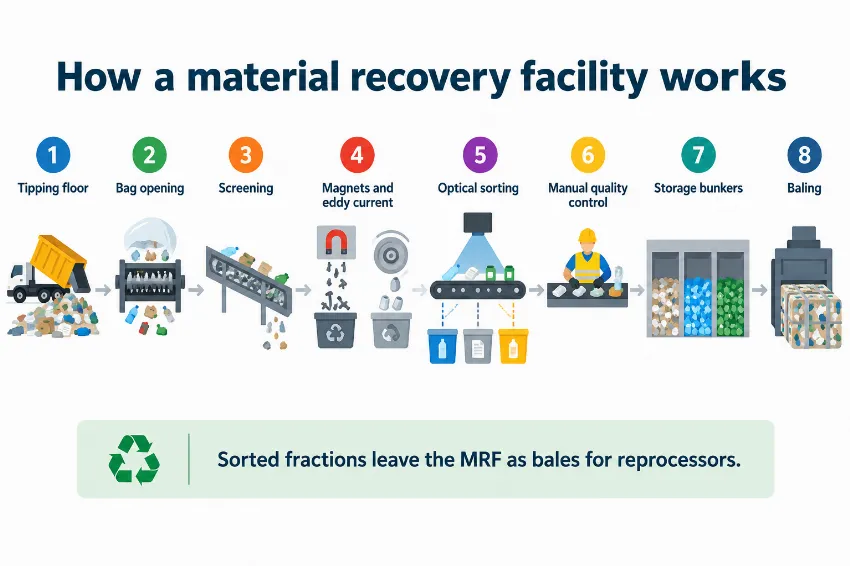
The processing architecture of a sorting plant is linear. Material moves continuously from bulk delivery to the final baling stage, passing through progressively finer separation technologies.
Tipping floor, infeed and bag opening
Collection trucks deposit raw material directly onto a concrete tipping floor. Front-end loaders push this bulk material onto a heavy-duty infeed conveyor. In facilities processing municipal waste, the first mechanical intervention is the bag opener. This machine rips open plastic refuse sacks without shredding the contents, ensuring a continuous, even flow of material onto the primary sorting line.
Screens, magnets, eddy currents and optical sorters
The mechanical sorting phase separates items by size, weight, and material properties.
- Trommel or disc screens: Separate large items (like OCC – old corrugated cardboard) from smaller containers and fines (glass shards, dirt).
- Overband magnets: Extract ferrous metals, such as tin cans and steel containers.
- Eddy current separators: Repel non-ferrous metals, ejecting aluminium cans from the belt.
- Optical sorters (NIR): Use Near-Infrared technology to identify specific plastics (PET, HDPE) and deploy precise air jets to shoot them into designated chutes.
Manual quality control in picking cabins
Automation handles the bulk of the work, but manual picking stations ensure final quality. Workers positioned in climate-controlled cabins visually inspect the sorted streams, removing anomalies, hazardous items, or heavily contaminated pieces the machines missed. We design our sorting lines so that these manually verified fractions drop directly into dedicated storage bunkers located beneath the cabin.
Which materials an MRF recovers and where they go
Facilities isolate materials based on market demand. The dominant recovered fractions are paper, cardboard (OCC), PET bottles, HDPE containers, ferrous metals, and aluminium. End markets dictate the required purity levels; even minor contamination can drastically reduce a bale’s selling price.
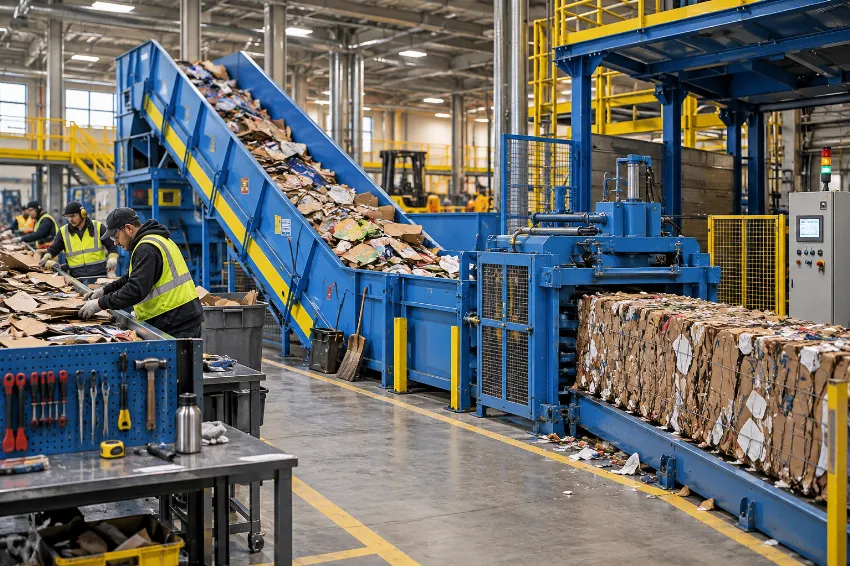
Paper and cardboard consistently dominate the volume. In 2018 more than 69 million tons of US municipal solid waste were recycled, with paper and paperboard accounting for about 67 percent of that amount (Source: US EPA, National Overview: Facts and Figures on Materials, Wastes and Recycling). The situation is similar in Europe; in 26 of the 27 EU countries, paper and cardboard made up the largest share of packaging waste in 2023 (Source: Eurostat, Packaging waste statistics).
Once baled, these materials ship directly to reprocessors. Paper mills pulp the OCC to make new boxes. Plastic processors wash and flake PET to manufacture new bottles or polyester fibres. Foundries and steelmakers melt down the compressed metal bales to create new industrial components.
From storage bunkers to the baler
Most industry literature stops at the sorting process. However, the final stage—moving separated materials into the baler—is where operational bottlenecks most frequently occur. Proper handling in this “last meter” prevents jams and ensures continuous throughput.
Bunker discharge and in-floor chain conveyors
Selected materials accumulate in separated bunkers underneath the sorting cabin. When a bunker reaches capacity, operators open the bay doors to discharge the fraction onto an in-floor chain conveyor. This heavy-duty conveyor transports the material directly into the baling press hopper. Integrating the bunker storage seamlessly with the feed conveyor eliminates the need for manual reloading with forklifts. Understanding exactly how to prepare material for baling at this stage prevents bridging in the hopper and maximises the t/h capacity of the entire plant.
Auto-tie baling and bale quality
The discharged material feeds into a robust auto-tie channel baling press. In typical ANIS installations, we utilise machines like our ATS 110 x 110 series, which features optimal bale dimensions for truck loading. Because material flows change rapidly in an MRF, the press is equipped with a SIEMENS PLC controller. This software features pre-set programs adjusted for different materials. The operator simply selects the material name on the Touch Panel, and the baler automatically adjusts its pressing force and cycle parameters to handle OCC, PET, or aluminium without manual recalibration.
Deciding on the final compaction equipment requires careful evaluation. A direct waste compactor vs baler analysis reveals that while compactors are suitable for general waste transport, highly compacted, wire-tied bales are mandatory for secondary raw material markets. High bale density dictates your selling price. Choosing the right machinery—often explored in a comprehensive horizontal baler guide—ensures heavy, well-shaped, and stackable bales. This allows operators to fully exploit truck weight limits (up to 24 tonnes per trailer), drastically cutting transport logistics costs.
What limits MRF recovery rates?
No facility operates at 100% recovery efficiency. The primary limitation is the input contamination rate. When residents place food-soiled items, tanglers (like hoses and cables), or non-recyclable plastics into single-stream bins, these items disrupt mechanical sorting.
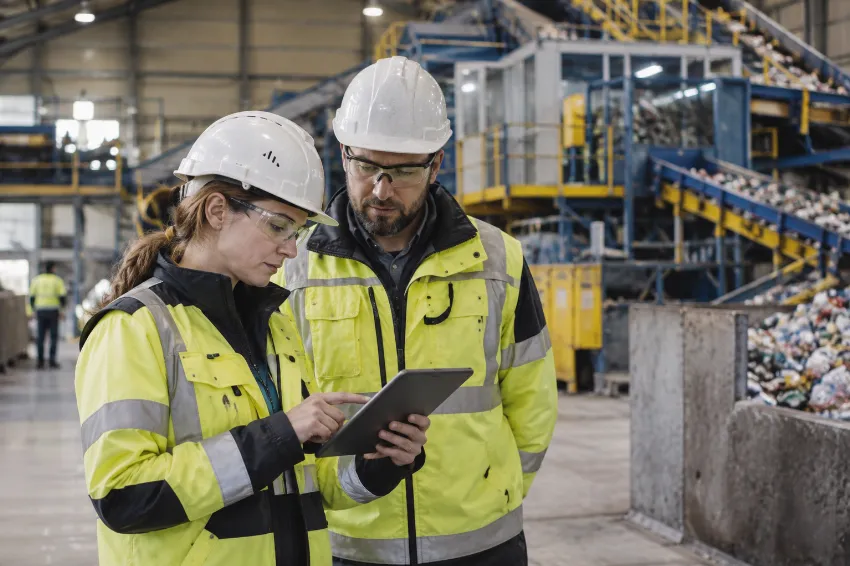
The unrecoverable fraction is known as MRF waste or residue. These are materials that either lack a viable end market or are too contaminated to be sold. Depending on the facility’s technology and the local sorting habits, residue rates typically range from 10% to 25%. This waste fraction is generally routed to landfills or waste-to-energy incineration plants.
Planning or upgrading an MRF: key design decisions
When designing a new sorting facility or upgrading an existing one, operators face strict footprint and capacity constraints. Throughput requirements must align with local waste generation volumes and expected population growth.
Space is usually the biggest constraint. The layout must accommodate the tipping floor, the multi-level sorting line, and the logistics area for bale storage. For facilities dealing with cramped spaces, integrating a compact baler for recycling centres ensures high-specific pressing force (up to 205 tonnes) without demanding excessive floor space. Choosing equipment that offers both Preflap (pre-press) and Shear (cutting) technologies gives the facility the flexibility to handle the widest possible range of materials as market demands shift.
Summary of MRF operations
A successful material recovery facility integrates advanced mechanical separation with heavy-duty material handling. While screens and optical sorters isolate the valuable fractions, the true efficiency of the plant relies on how seamlessly those materials move from storage bunkers to the baling press. High-quality, automated baling with intelligent PLC control ensures that the sorted materials are transformed into highly dense, stackable bales, providing the best return on investment and enabling a circular economy.
Frequently asked questions
What is the difference between a clean and dirty MRF?
A clean MRF processes commingled recyclables that have already been separated from general household waste by consumers. A dirty MRF receives mixed municipal solid waste, requiring heavy mechanical and manual sorting to extract recyclables from the raw refuse.
How is material moved from sorting lines to the baler?
Sorted fractions are temporarily stored in bunkers beneath the picking cabins. Once full, the bunkers discharge the material onto an in-floor chain conveyor, which feeds directly into the baler’s hopper for continuous operation.
Why is bale density important for a material recovery facility?
Bale density directly impacts logistics and profitability. Heavy, highly compacted, and neatly shaped bales allow operators to maximise truck loading weights, significantly reducing transport costs and commanding better prices from material reprocessors.
Can one baler handle multiple types of materials?
Yes, modern auto-tie channel balers use advanced PLC controllers with pre-set programs. Operators can switch between pressing cardboard, plastics, or aluminium by selecting a recipe on the control panel, ensuring optimal compaction for each specific fraction.
Optimising your waste management logistics requires equipment tailored to your specific material flow. Get a quote for a high-performance sorting line with an integrated ANIS auto-tie baler, customized precisely to your facility’s throughput requirements and footprint.