


Choosing between single loop bale ties, box wire and stem coil directly influences the uptime, labour requirements and consumable costs of any recycling facility. The decision between these pre-cut lengths, boxed coils or heavy-duty carriers rests entirely on the design of the compaction equipment and the required throughput per shift. For a broader overview of material grades, gauges and tensile strengths, explore our complete baling wire guide.
Facility managers evaluating their operating expenses must look beyond the raw price per kilogram of steel. The format in which the wire is delivered determines how often an operator must halt the sorting line to perform a changeover. Understanding the mechanical compatibility of these formats ensures the press operates at its designed capacity without unnecessary interruptions.
Table of Contents
What dictates the choice between bale ties, box wire and stem coils?
The correct wire format is dictated by the machine’s tying mechanism and daily production volume. Manual tie presses require pre-cut bale ties, mid-volume automated balers utilise 45 kg box wire, and continuous high-throughput channel presses demand 800 kg stem coils to eliminate frequent production stops.
What is the difference between bale ties, box wire and stem coil?
The core difference between these three formats lies in their packaging, weight and the method by which they are fed into the baling chamber. Equipment manufacturers specify exact formats because the tensioning devices and guide tracks are engineered for specific delivery methods.
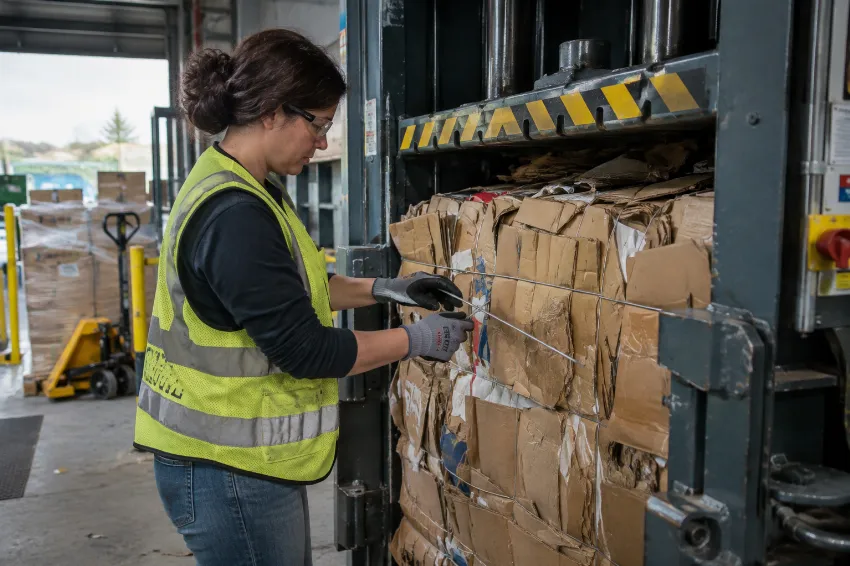
Pre-cut wires are manufactured to exact lengths and feature a pre-formed loop at one end. Box wire, conversely, is continuously coiled into compact, manageable cardboard containers designed for automated feeding on smaller machines. Carrier wire provides industrial-scale continuity, replacing the manual handling of smaller boxes with forklift-loaded steel frames.
Single loop bale ties: when manual tying makes sense
Single loop bale ties are pre-cut lengths of wire designed exclusively for manual application. These are typically manufactured from black annealed or galvanized steel and are bundled in exact quantities. An operator must physically guide the wire around the compacted material and secure the loop by hand before the press ram retracts.
This format is the industry standard for any manual tie vertical baler. Smaller retailers, distribution centres and low-volume recycling facilities rely on this method because the initial capital expenditure for a manual press is significantly lower than that of an automated system. The materials most commonly baled with this format include cardboard boxes and plastic film, which do not require extreme pressing forces.
The limitation of manual tying becomes apparent as volume increases. Securing multi-material bales by hand requires physical exertion and creates a bottleneck in the workflow. If a facility consistently exceeds processing targets, the labour cost associated with manual tying rapidly outweighs the savings on equipment.
Box wire: the standard for smaller auto-tie balers
Box wire serves as the entry point into automated waste compaction. Supplied in 45 kg corrugated boxes, this format feeds directly into an auto-tie horizontal baler. As the machine reaches the programmed bale length, the needles pull the wire around the material, and the knotter assembly twists and cuts the connection without operator intervention.
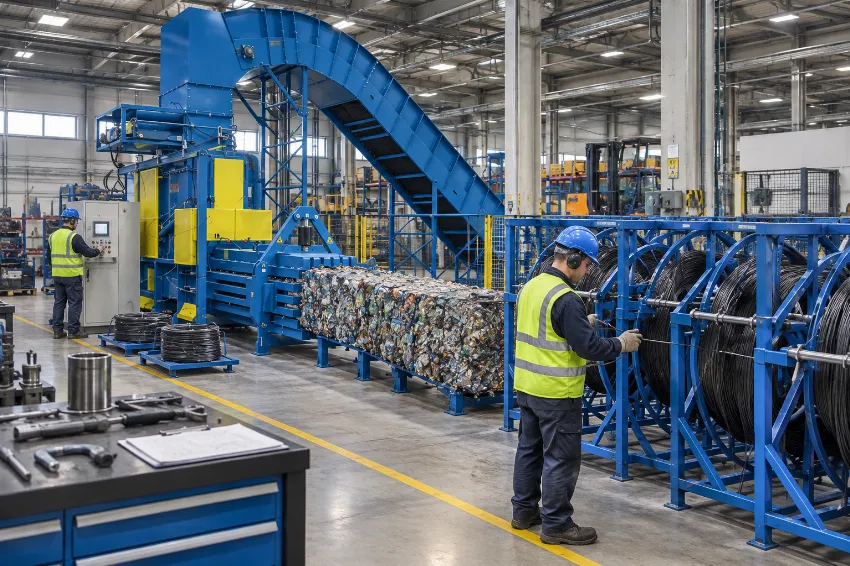
The 45 kg format is manageable enough that a single operator can handle the changeover without heavy lifting equipment. Facilities operating at moderate capacities benefit from this format as it balances the convenience of automatic tying with straightforward storage requirements. Most standard automatic wire tying systems are calibrated to pull from these specific coils.
A typical 45 kg box provides enough continuous wire for several hours of operation, depending on the bale dimensions and material density. However, in a material recovery facility (MRF) running multiple shifts, changing these boxes requires halting the press multiple times a day, which accumulates into measurable production losses.
Stem coils and big carriers for high-throughput channel balers
Operations managing municipal solid waste, high volumes of PET or industrial edge trims rely on heavy-duty channel baling presses. These machines demand carrier wire. Delivered on large wooden pallets or steel tubular frames, these coils range from 400 kg up to 800 kg, providing a massive, uninterrupted supply of tensile strength.
High-specific pressing forces (reaching up to 205 tonnes in ANIS channel balers) produce extremely dense, stackable bales that require robust containment. Large stems ensure that the press can operate continuously for days without a coil changeover. This continuous operation maximises the return on investment for sorting plants.
Handling carriers requires forklift access and dedicated floor space behind the machine. The wire is pulled off the stem through specific wire coil holders and guides that prevent tangling as the heavy wire accelerates towards the knotting needles.
Which wire format fits your baler and volume?
The format you select must align perfectly with your machine’s mechanical constraints and your daily throughput demands. Using an incompatible wire setup leads to tension faults, broken knots and compromised bale integrity.
| Format | Compatible Baler Type | Typical Application | Coil Changeover | Advantage |
|---|---|---|---|---|
| Single loop bale ties | Vertical presses, manual horizontal balers | Retail stores, low-volume distribution | Manual per bale | No automated equipment required |
| Box wire (45 kg) | Smaller auto-tie horizontal balers | Mid-sized recycling centres | Multiple times per shift | Easy handling without forklifts |
| Stem coil (800 kg) | Heavy-duty channel baling presses | MRFs, industrial processing plants | Once every few days | Maximum operational uptime |
Baler type and tying system
The physical structure of the tying mechanism dictates compatibility. To accommodate different facility setups, ANIS balers are available with three distinct coil systems: holders designed for small coils up to 45 kg, robust frames accommodating large coils up to 800 kg, and large coil systems engineered specifically for plastic wire.
Evaluating bale ties vs box wire ultimately comes down to whether the machine features mechanical needles and twisting heads. If the press lacks an auto-tie system, pre-cut loops remain the only viable option.
Bales per shift and coil changeover time
To assist with continuous feeding from large carriers, ANIS machines integrate wire straighteners as standard equipment. This ensures the heavily memory-bound steel feeds accurately into the knotter.
For optimal baler management, integrating an optional hydraulic wire tensioner alongside wire run-out control improves the handling of heavy gauge material. Choosing an 800 kg stem drastically reduces the total hours lost to coil changeovers each month, directly increasing the number of bales per shift. For precise specifications on wire thickness required for these operations, operators should consult the baling wire gauge chart.
Storage, handling and buyer requirements
Different materials exert varying levels of expansion force once the press ram retracts. The correct application of wire is critical to meet international logistics and buyer standards. Highly compacted and stackable bales for optimal truck loading require precise strapping parameters.
Industry standards strictly govern how materials should be secured for downstream processing. Regarding secondary containment methods, APR model bale specifications state that a minimum number of bale wires should be used to maintain bale integrity, and that plastic wrap or other binding beyond bale wire should not be used (Source: Association of Plastic Recyclers, Model Bale Specification: Mixed Small Rigid Plastics). This reinforces the necessity of relying entirely on high-quality steel or specialized plastic wire.
Summary
Selecting between single loop bale ties, boxed coils or heavy stems is a structural decision tied to facility output. Manual systems rely on pre-cut loops, while mid-range operations utilise 45 kg boxes for easy handling. High-capacity material recovery facilities demand 800 kg stems to maintain continuous production, prevent downtime and ensure maximum efficiency during auto-tie operations.
Frequently asked questions
Can the same baler use different wire formats?
In most cases, an automated baler configured for 45 kg boxes can be upgraded to accept 800 kg stems by installing heavy-duty external coil holders and wire guides. A manual tie baler, however, cannot be converted to use continuous coils without installing an entirely automated tying module.
When should a facility switch from manual tying to automatic box wire?
The transition is justified when operator labour costs for manual tying exceed the depreciation and maintenance costs of an automated tying system. Usually, facilities producing more than a few bales per hour observe a rapid return on investment by upgrading to an auto-tie horizontal press.
What causes wire breakage during coil changeovers?
Breakages typically occur when the new wire is improperly threaded or if there is a mismatch in tensile strength for the material being compacted. Lack of a proper wire straightener or inadequate tension control also leads to knot failures during the first few cycles after a changeover.
To ensure your sorting plant operates without unnecessary bottlenecks, we recommend evaluating your current throughput. Contact the team at ANIS Trend to check which wire coil system—small 45 kg boxes, large 800 kg stems, or plastic wire formats—best fits your specific baler model and your target bales per shift.