


Evaluating cardboard baler cost goes far beyond checking the initial purchase price on a supplier’s quotation. Facility managers and recycling plant operators often focus heavily on the capital expenditure (Capex), ignoring the long-term operational expenses (Opex) that dictate the true financial impact of the machinery. To understand the actual financial commitment, operators must analyse energy consumption, wire usage, labour hours, and maintenance requirements over the machine’s entire lifecycle.
At ANIS Trend d.o.o., we have spent over 25 years designing and manufacturing robust pressing equipment. This experience shows that the most profitable investments stem from a complete understanding of total cost of ownership (TCO) and expected return on investment (ROI). For a complete overview of our specific horizontal configurations and technical parameters, you can explore our horizontal baler guide.
Table of Contents
How much does a cardboard baler cost?
The exact cardboard baler cost depends primarily on the machine type, pressing force, and automation level. While manual vertical models require lower initial capital, fully automatic horizontal channel balers demand a higher upfront investment but deliver significantly lower per-tonne running costs and higher long-term profitability.
Auto-tie channel baler is a fully automatic horizontal pressing machine that continuously compacts waste materials into highly dense, stackable units and secures them with wire without manual intervention. This engineering approach eliminates continuous operator presence, thereby drastically reducing labour expenses per processed tonne.
How much does a cardboard baler cost to buy?
The initial cardboard baler price varies widely across the market, dictated by the capacity requirements and structural integrity of the machine. Manufacturers typically segment their equipment based on throughput expectations. For instance, we offer solutions ranging from Low Production Volume systems suitable for smaller distribution centres, to Med & High Load baler series engineered for municipal recovery facilities (MRFs) and intensive industrial applications. Every increase in pressing force, feed hopper size, or hydraulic power directly influences the base acquisition cost.
Furthermore, assessing whether a facility needs a standard waste compactor vs baler changes the financial equation. Compactors merely reduce volume for transport, whereas balers create structured, marketable commodities. The purchase price of a baler reflects its ability to generate revenue rather than simply manage waste disposal.
Vertical balers
Vertical machines represent the entry point into waste compaction. These units require a minimal footprint and represent a lower capital investment. However, they rely entirely on manual operation for loading, pressing, and tying. The operator must physically remain with the machine during the compaction cycle, which elevates the labour cost per bale. For a detailed technical contrast between configurations, read our horizontal vs vertical baler comparison.
Horizontal and channel balers
Horizontal equipment shifts the financial burden from operational labour to the initial purchase price. These systems use automated feed conveyors, tipping devices, or air transport systems for continuous loading. ANIS channel baling presses, for example, feature versatile Preflap & Shear technologies to handle various materials. Depending on the density required, facilities can choose between a pre-press method with a single flap or a pre-press method with double lateral flaps. Components like Dorninger hydraulic cylinders and SIEMENS PLC controllers increase the upfront invoice but provide the structural reliability needed for a rapid payback period.
The running costs most quotes leave out
A common procurement mistake is evaluating baler cost solely on the capital expense. Operational expenditure will inevitably surpass the purchase price over the machine’s lifespan. An accurate financial projection must incorporate the recurring costs required to keep the system running efficiently.
Energy, baling wire and wear parts
Electrical consumption and consumables form the baseline of daily operations.
- Energy consumption: Systems must be developed to achieve an optimal hourly performance to energy consumption ratio. Compact hydraulic power packs with noise-optimised main drives minimise unnecessary power draw.
- Baling wire: The wire consumption per bale fluctuates based on bale dimensions and expansion force. Automatic horizontal wire tie systems regulate tension precisely, preventing wire waste and ensuring optimal bale stability. Our baling wire guide explains how gauge and format affect this cost.
- Wear parts: Internal abrasion degrades standard steel quickly. ANIS machines use HARDOX® wear-resistant internal coatings and replaceable shear blades. The bolted fixing of these plates ensures easy replacement, reducing long-term spare part costs compared to machines requiring intensive welding repairs.
Labour time per bale
Manual intervention is the most expensive operational variable. With older or highly manual equipment, operators spend hours sorting material, clearing jams, and manually tying wire. Technologically advanced channel presses feature fully automatic running and fast, simple pressing cycles. The Touch Panel facilitates machine operation through recipe management, allowing the software to automatically adjust to different materials without requiring manual recalibration. This automation drastically lowers the labour time allocated to each processed tonne.
Service, downtime and operator safety
Unplanned downtime halts facility logistics. When a baler fails, loose cardboard accumulates, blocking operational space and requiring emergency hauling. Regular maintenance contracts mitigate this risk.
Processing machinery also presents inherent industrial hazards. According to NIOSH, 34 US workers were killed between 1992 and 2000 when caught in or crushed by the rams of baling or compacting machines (Source: NIOSH, NIOSH Identifies Hazards of Baling Equipment). CE-compliant equipment includes enclosed constructions, lateral secured polycarbonate glass doors, and electrical systems protected by double contact breaker isolation, and ANIS manufactures under an ISO 9001:2015 certified quality system. Investing in proper safety features directly prevents costly workplace incidents.
What a cardboard baler earns back
A baler turns corrugated cardboard (OCC) from a disposal liability into a revenue-generating asset. High specific pressing forces yield heavy, well-shaped, and stackable bales. Optimised bale dimensions allow for efficient full truck loading, pushing payloads to maximum legal limits (often 24 tonnes per trailer). Discover more about how a cardboard baler optimizes transport costs through efficient logistics.
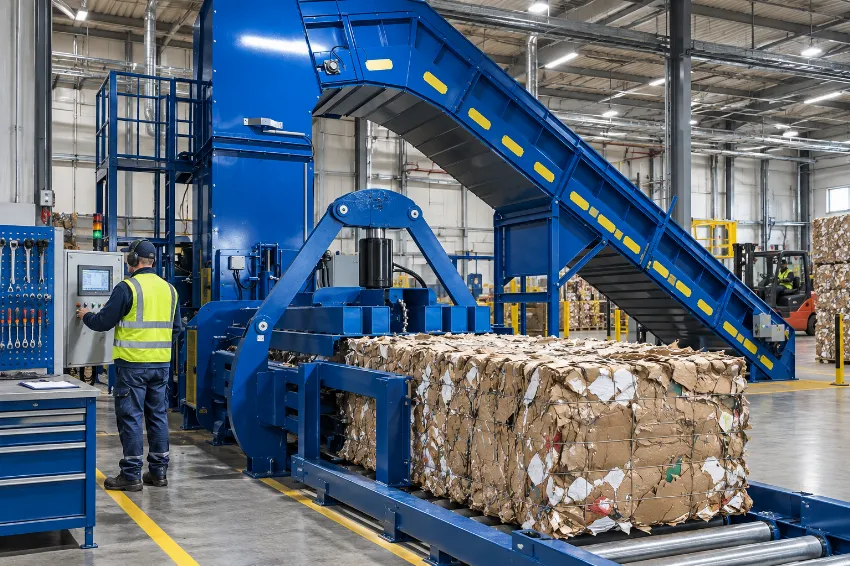
Selling these standardised bales to paper mills or recyclers provides a direct financial rebate per tonne. Global recycling initiatives continue to drive demand for clean OCC. The recycling rate for corrugated boxes in the US was 96.5 percent in 2018, about 32.1 million tons recycled (Source: US EPA, Containers and Packaging: Product-Specific Data). Similarly, European rules enforce strict material recovery: EU packaging legislation sets a minimum 2030 recycling target of 85 percent for paper and cardboard packaging (Source: Eurostat, Packaging waste statistics). Facilities equipped with robust baling solutions are well positioned to benefit from these targets.
How to calculate total cost of ownership
Establishing the true financial footprint requires calculating the Total Cost of Ownership (TCO) over a projected operational period (typically 7 to 10 years). The fundamental TCO equation incorporates all capital, operational, and maintenance expenses, minus the revenue and savings generated.
Formula: TCO = (Purchase Price + Installation) + (Energy + Wire + Labour + Maintenance + Downtime) – (Hauling Savings + Bale Revenue)
| Cost category | Specific variables to calculate | Financial impact |
|---|---|---|
| Capital Expenditure (Capex) | Machine price, delivery, installation, conveyor integration, commissioning. | One-time upfront cost. Represents the base depreciation value. |
| Consumables & Utility (Opex) | kWh per tonne, wire consumption per bale, hydraulic oil replacement. | Continuous variable costs scaling directly with throughput. |
| Maintenance & Parts (Opex) | Service contracts, HARDOX® plate replacement, shear blade rotation. | Periodic fixed and variable costs. Extends machine lifespan. |
| Labour (Opex) | Operator hours per shift dedicated to loading, tying, and bale handling. | Highest variable cost in manual systems; minimal in auto-tie systems. |
| Revenue & Savings (Return) | Rebate per tonne of OCC, reduction in weekly waste collection fees. | Directly offsets Capex and Opex, determining the payback period. |
Buy, lease or rent: how financing changes the picture
Acquiring equipment for your specific cardboard baler industry application offers multiple financial pathways. Outright purchase demands significant upfront liquidity but yields the lowest overall TCO over a ten-year lifespan, as no interest or premium is applied.
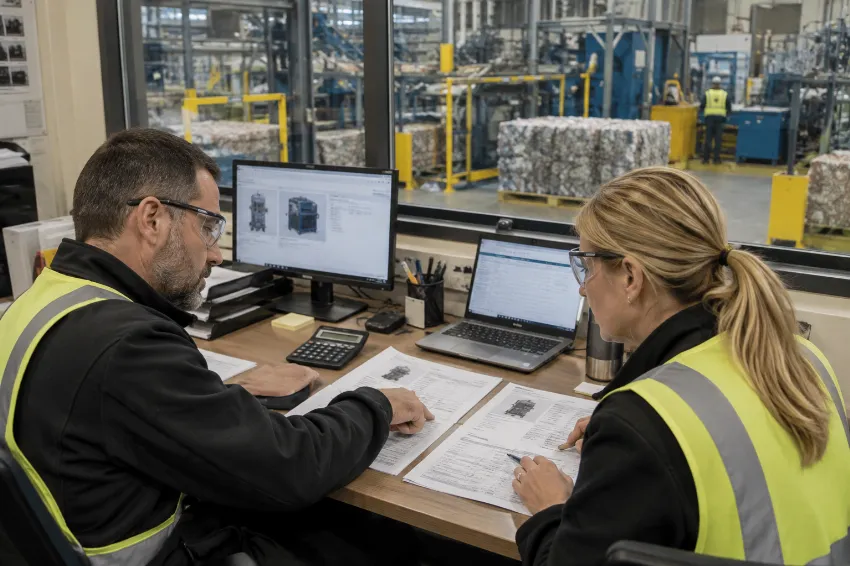
Leasing arrangements transition the acquisition from Capex to Opex. This structure preserves corporate cash flow and often includes maintenance packages, making monthly expenses highly predictable. Rental agreements provide maximum flexibility for short-term projects or facilities experiencing rapid, unpredictable volume growth, though they generally present the highest long-term cost.
Summary
Determining how much a baler costs requires a holistic financial approach. While the initial quotation covers the machine’s structural and technical features, the true expenditure lies in daily operations, energy use, and maintenance. Heavy-duty construction, integrated safety features, and high automation levels increase the initial price but drastically reduce labour and maintenance costs. Simultaneously, the production of highly compacted, stackable bales generates consistent revenue and minimises transport fees, ensuring a reliable return on investment.
Frequently asked questions
What is the average payback period for a cardboard baling machine?
The payback period typically ranges from 12 to 36 months, depending on the volume of cardboard processed and the current market rebate for OCC bales. High-volume operations using fully automatic channel balers achieve faster break-even points due to minimised labour and maximum transport efficiency.
Which hidden expenses impact the final cardboard baler price?
Many initial quotes exclude site preparation, specialised electrical installations, and the integration of feed conveyors or tipping devices. Additionally, buyers often overlook the cost of replacing internal wear parts, which is why systems using easily replaceable HARDOX® plates offer better long-term value.
Does machine automation reduce the overall baler cost?
While automation increases the capital purchase price, it significantly lowers the total cost of ownership. Automated feeding and auto-tie wire systems eliminate the need for a dedicated manual operator, reducing weekly labour expenses and increasing hourly throughput.
Ready to determine the exact ROI for your facility? Send us your monthly cardboard volume and current hauling costs and request a quote for your tonnage. Our engineering team will provide a comprehensive TCO calculation and propose an optimally adjusted ANIS baler to maximise your profitability.