


The baler vs compactor decision determines whether your facility pays to dispose of waste or earns revenue from secondary raw materials. A compactor crushes mixed refuse into a closed container to reduce the frequency of waste collection trucks visiting your site. A baler, conversely, presses sorted, clean recyclables into dense, tied blocks that you can sell directly to paper mills or plastic recyclers.
Making the wrong choice usually results in either contaminated recycling streams that lose their market value or excessive manual labour spent on materials that should have gone straight to a landfill. This equipment decision shapes the efficiency of your internal logistics, and you can see how it fits into the broader picture of sorting equipment within our guide on how a modern MRF works.
Table of Contents
What is the main difference between a baler and a compactor?
The main difference between a baler and a compactor lies in the material processed and the final output. A waste compactor compresses mixed general waste into a closed container to reduce hauling frequency, whereas a baler compresses clean, sorted recyclables into tied blocks that can be sold for profit.
Baler vs compactor: what is the core difference?
The most reliable way to differentiate these two industrial machines is by examining their end goal. Compactors are volume-reduction tools for rubbish destined for the landfill. Balers are packaging tools for commodities destined for the recycling market. Understanding this distinction is the first step in assessing a site’s requirements.
Source separation is the practice of sorting different types of waste materials (such as corrugated cardboard, plastics, and metals) at the point of generation rather than mixing them. This process is a mandatory prerequisite for using a baling press effectively, as mixed materials cannot form a commercially viable bale.
To provide a clear decision framework, the table below outlines the operational differences when comparing a waste compactor vs baler.
| Criteria | Baling Press | Waste Compactor |
|---|---|---|
| Primary Purpose | Creates marketable recycling bales | Reduces volume of mixed general waste |
| Input Material | Clean, separated streams (OCC, PET, cans) | Mixed, wet, or non-recyclable general waste |
| Output Format | Tied, stackable bales | Loose compressed waste inside a sealed bin |
| Financial Return | Generates a rebate from recycling mills | No rebate; reduces transport fees only |
| Space Requirement | Requires indoor operation and bale storage space | Usually stationed outdoors (roll-off container) |
What a waste compactor does well
A compactor excels at handling unsegregated, low-value waste streams. Facilities such as hospitals, large retail centres, and mixed manufacturing plants generate substantial amounts of general waste that cannot be practically sorted. In these environments, throwing everything into a self-contained compactor or a roll-off container is the most hygienic and time-efficient approach.
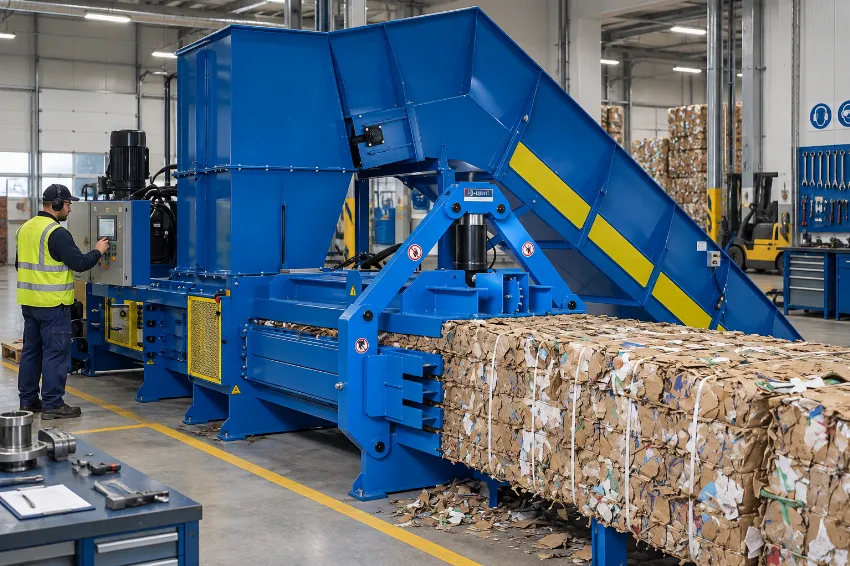
By applying hydraulic pressure, these machines eliminate the dead air inside standard bins. This means a site that previously required four waste collections per week might only need one, drastically cutting down on logistics costs and site traffic. Compactors handle wet waste effortlessly, which is why self-contained units with liquid-tight seals are standard practice in the food industry.
While some sites use them for cardboard out of convenience, doing so sacrifices the material’s market value. If a facility has zero interest in selling recyclables and only wants to clear space quickly, evaluating the key features of a heavy-duty cardboard compactor remains a valid, albeit strictly cost-driven, alternative.
What a baler does well
A baler transforms loose packaging waste into a highly dense, stackable commodity. When a facility separates its cardboard, plastics, or aluminium cans from the general waste stream, processing them through a baling press protects the clean fraction and turns a waste disposal cost into a revenue stream.
The scale of this material stream is massive. Corrugated boxes were the largest single product category of US municipal solid waste in 2018 at 33.3 million tons generated (Source: US EPA, Containers and Packaging: Product-Specific Data). Managing such volumes requires specialised technology.
At ANIS Trend, our philosophy of “Baling solutions driven by experience” comes from performing over 350 installations globally. We design auto-tie channel baling presses equipped with pressing forces up to 205 tonnes. Unlike manufacturers who strictly advocate a single technology, we supply both shear (cutting) and pre-flap (pre-press) technologies. A pre-press with a big single flap handles PET and plastic film exceptionally well, whereas double lateral flaps manage extreme high-throughput requirements for multi-material bales. For a deeper look at the mechanics, review what a baler does to secondary raw materials.
Five questions that decide it for your site
Choosing the right machine requires looking past the equipment itself and analysing the logistics, financial models, and physical layout of the facility. The following questions form a proven decision framework.
How much of your waste is clean and recyclable?
The volume of clean, sorted material directly dictates the machine type. If your waste stream consists of more than 70% clean cardboard (OCC) or plastic packaging, installing a baler is the standard industry response. Pushing high volumes of pure recyclables into a compactor means paying landfill taxes on materials that recycling centres actively want to buy.
How are you charged for collection?
Your hauling contract determines where your savings will come from. If the waste contractor charges a flat fee per container pull (hauling frequency), a compactor aggressively cuts those transportation costs by fitting more material into fewer trips. If you pay per tonne, reducing volume does not change the weight; in this scenario, diverting weight into a baler to earn a material rebate is mathematically superior. For a strict financial calculation on equipment returns, consult our analysis on cardboard baler cost and TCO.
How much space and labour do you have?
Space and available workforce act as hard constraints on equipment choices. Balers generally operate indoors to protect the electrical systems and the quality of the paper/cardboard bales, requiring floor space for the machine and the stacked output. They also require operators to manage the feeding hopper or conveyor. Compactors sit outside in the loading bay, taking up zero warehouse space, and require virtually no operator training beyond pressing a button.
There are exceptions to the space rule. For cramped sorting plants, we manufacture a Small Format Can Baler with a compact frame construction. This machine produces highly dense 40 x 40 cm bales of tin/steel cans, proving that high compaction does not always require massive square footage.
- Market value of bales: Assess current local prices for OCC or PET; high market rates heavily favour baling.
- Future site expansion: A facility expecting growth should consider channel balers that can integrate with continuous feed conveyors, rather than manual-feed standalone units.
When running both machines makes sense
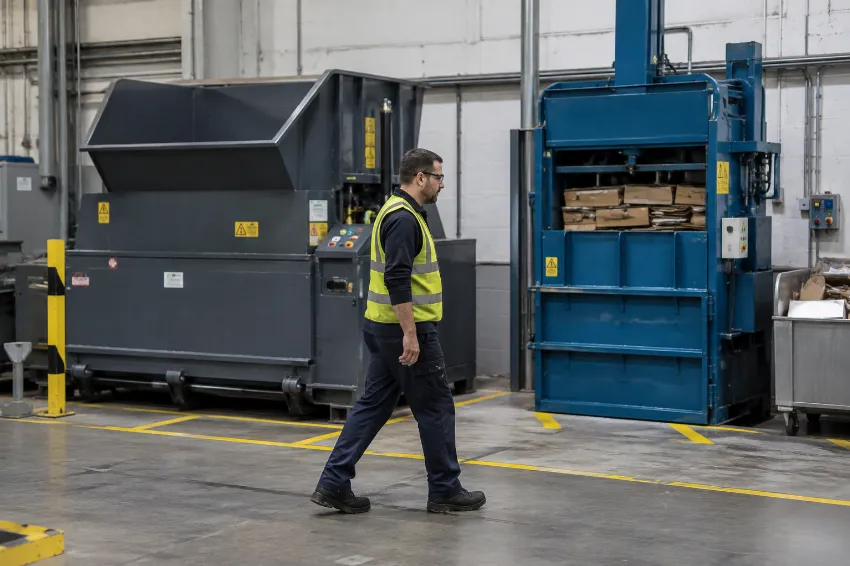
In large-scale operations, deciding between a compactor vs baler is often a false dichotomy. Major distribution centres, sorting plants (MRFs), and manufacturing hubs regularly deploy both technologies simultaneously to handle distinct waste streams.
A typical setup involves a large channel baler positioned inside the facility, fed continuously by conveyor belts. This machine processes the massive influx of packaging materials—cardboard boxes, shrink wrap, and edge trims. Simultaneously, an external self-contained compactor manages the cafeteria waste, office rubbish, and non-recyclable sweeping debris.
Operating both machines optimises logistics entirely. The clean fractions generate maximum revenue as heavy, well-shaped bales for optimal truck loading, while the general waste is compacted to minimise expensive landfill hauls. In these dual-machine environments, standardising maintenance routines and establishing strict safety protocols across the entire site becomes the primary operational focus.
Summary of your equipment choice
Selecting the correct waste processing equipment fundamentally alters a facility’s operational costs. A compactor remains the undisputed choice for mixed, wet, and general waste, offering unparalleled reductions in collection frequency and keeping outdoor areas hygienic. Conversely, a baler is a strategic investment for any business handling significant volumes of sorted packaging.
By assessing the clean fraction of the waste stream, the structure of current hauling contracts, and the physical constraints of the site, operations managers can specify machinery that turns waste management from an unavoidable expense into an efficient, and often profitable, logistical process. Whether integrating a small metal baling press or a high-capacity channel baler, the objective is always to reduce operating costs while preserving valuable secondary raw materials.
Frequently asked questions
Can a compactor crush cardboard for recycling?
Yes, a compactor can physically crush cardboard, but doing so mixes it with general waste and permanently ruins its recycling value. Paper mills require clean, baled cardboard (OCC) free from liquid and food contamination. If you compact cardboard, you will pay landfill disposal fees instead of receiving a recycling rebate.
Which machine is safer to operate?
Both machines require strict adherence to lockout/tagout procedures, as they utilise powerful hydraulic rams. Fatalities at balers and compactors generally involved workers entering the machine to clear a jam, falling into the path of the ram or reaching in while it was operating (Source: NIOSH, NIOSH Identifies Hazards of Baling Equipment). Modern machines from reputable manufacturers feature enclosed constructions, lateral secured polycarbonate glass doors, and double contact breaker isolation to prevent these hazards.
Is a compactor or baler cheaper to buy?
Basic outdoor waste compactors typically carry a lower initial purchase price than automated channel balers, primarily because compactors require less complex tying systems and software. However, because balers generate a direct revenue stream from selling recyclables, they routinely offer a much faster return on investment (ROI) over a typical five-year operational lifecycle.
Need help configuring your waste logistics?
Every facility has unique throughput requirements and material compositions. Describe your site’s specific waste stream—including the estimated share of cardboard and plastics, and your current collection method—and our engineering team will propose the exact baler, compactor, or integrated combination that delivers the best return on investment for your business. Contact ANIS Trend to engineer a tailored solution.