


Evaluating the transition point between manual and automated waste compaction requires looking beyond the initial purchase price. The true cost of a baling operation lies in recurring operator wages and transport logistics. Choosing between a horizontal vs vertical baler demands a precise financial analysis based on your specific monthly material volume, labor rates, and freight distances.
For a broader look at machine specifications and capabilities, this analysis builds directly on our horizontal baler guide. In the industrial recycling sector, relying solely on machinery specification sheets often leads to incorrect capital investments. Facility managers must calculate the exact tonnage at which the automated features of a larger press pay for themselves through reduced manual handling and optimized transport payloads.
At what volume should I switch to a horizontal baler?
In most cases, the break-even point to switch from a vertical to an auto-tie horizontal baler occurs between 50 and 150 tonnes of material per month. At this volume, the continuous operational flow and labor savings from automated tying offset the higher capital cost.
The five axes everyone compares
Standard machinery evaluations typically focus on a predefined set of parameters. While these provide a foundational understanding of the equipment, they often lack the financial depth required for a definitive capital expenditure decision.
- Footprint: Upright models take up minimal floor space, making them suitable for retail backrooms. Channel presses require a dedicated operational zone for the machine, feed conveyors, and wire stands.
- Volume capacity: Upright machines are batch-fed manually. Channel machines offer continuous feeding via conveyors, tipping devices, or air transport systems.
- Capital cost: Initial investment for an upright press is significantly lower, whereas channel presses require substantial upfront capital.
- Labour intensity: Manual models demand constant operator presence for loading, initiating the press cycle, and wire tying.
- Material range: A vertical baler is typically dedicated to one stream, usually cardboard or film. Channel presses switch between OCC, paper, PET and foils on the same line.
From performing over 350 different installations around the world, we regularly see facilities outgrow their equipment because they focused entirely on capital cost rather than total operational efficiency.
The two nobody puts numbers on: labour and freight
The most substantial financial drains in a waste management facility are hidden within daily operations. The manual tie cycle represents a recurring wage cost that scales linearly with your waste volume. An operator running a manual machine spends an average of 10 to 15 minutes per bale completing the tying and ejection process. If a shift produces 10 bales, that equals up to 2.5 hours of dedicated, non-productive labor.
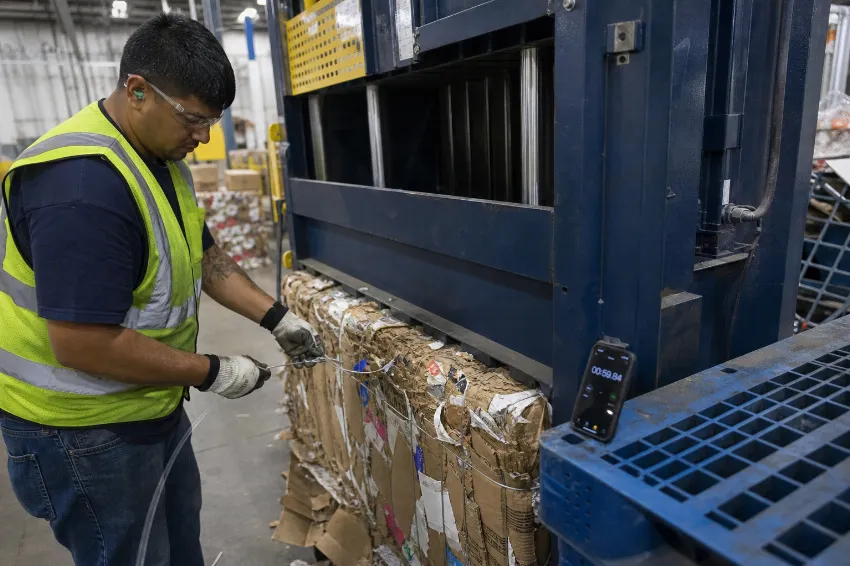
Safety is also a critical factor during manual operations. Frequent manual wire tying and bale handling increase the risk of musculoskeletal injuries, requiring adherence to strict safety protocols (Source: Health and Safety Executive).
Dead freight is the unused transport capacity paid for when loading low-density bales into a shipping trailer. This metric directly impacts transport profitability because logistics companies charge by the trip, regardless of whether the trailer reaches its maximum weight limit.
To eliminate this waste, equipment must generate heavy, well-shaped, and stackable bales for optimal truck loading. Every empty cubic metre inside a trailer represents a direct loss in profit margin, making payload per trailer a decisive factor in equipment selection.
At what tonnage does a horizontal baler win?
A horizontal baler wins and becomes the more profitable option when a facility processes over 50 tonnes of material per month. Below this threshold, the operational savings do not justify the capital expenditure of an automated system. Above 150 tonnes, relying on manual batch processing becomes economically unviable due to high labor costs and logistical bottlenecks.
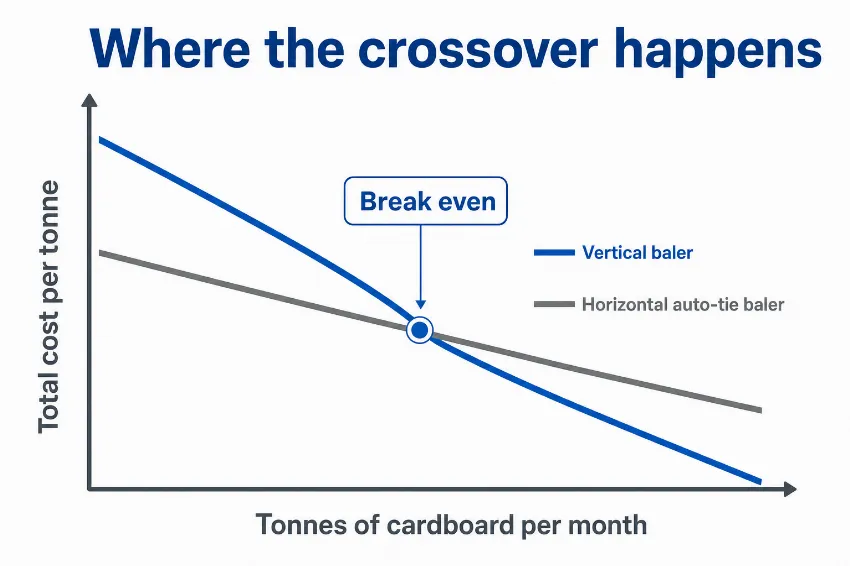
The transition zone between 50 and 150 tonnes is where specific facility metrics dictate the choice. If your labor costs are exceptionally high or transport distances are long, the automated system pays off closer to the 50-tonne mark. If operators are already on-site performing multiple duties and freight distances are minimal, a small vertical cardboard baler might remain viable longer.
This rule applies in most cases, except when a facility faces severe, unalterable space constraints in dense urban centres, forcing it to run multiple manual presses despite the higher labor costs simply because a continuous channel machine cannot physically fit inside the building.
A worked break-even calculation
To evaluate the real-world financial impact, we must state every assumption in the economic model. You can substitute these baseline figures with your own operational data.
- Assumptions: Monthly volume is 100 tonnes of cardboard. Operator wage is 20 EUR per hour. The manual press produces 400 kg bales and requires 15 operator minutes per bale. The automated press produces 600 kg bales and requires 2 operator minutes per bale for forklift removal.
- Manual costs: 100 tonnes requires 250 bales (100,000 kg / 400 kg). 250 bales multiplied by 15 minutes equals 62.5 labor hours. At 20 EUR per hour, the monthly labor cost is 1,250 EUR.
- Automated costs: 100 tonnes requires 167 bales (100,000 kg / 600 kg, rounded up). 167 bales multiplied by 2 minutes equals about 5.6 labor hours. At 20 EUR per hour, the monthly labor cost is about 111 EUR.
- The result: The automated system saves about 1,140 EUR in labor per month, or roughly 13,700 EUR per year, before counting freight savings from heavier bales. You can read more about evaluating the baler ROI calculation and labor savings to expand on this model.
Bale weight, trailer loads and the mill premium
Logistics economics dictate that full trailers maximize profitability. A standard European curtain-sider carries a payload of roughly 24 tonnes. If your machine produces light bales, the trailer fills up physically before it reaches the weight limit. Machines with high specific pressing force produce dense bales, so you ship fewer trailers for the same material volume. Optimizing these high bale density transport costs reduces both your freight expenditure and your carbon footprint.
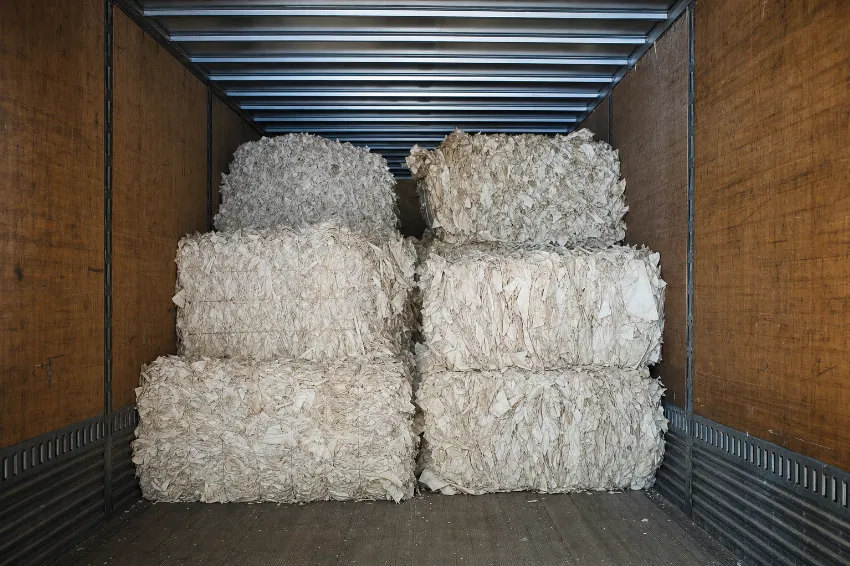
Paper mills buy against defined grades, and the ReMA Guidelines for Paper Stock set the acceptable contaminant and outthrow limits for each one. Dense, clean, mill-size bales that meet those grades are easier to sell and typically achieve better prices than loose or light material. Demand for this material is large: corrugated boxes were the largest single product category of municipal solid waste in 2018 at 33.3 million tons, with a recycling rate of 96.5 percent (Source: US Environmental Protection Agency).
Looking at market fluctuations in 2026, the value of baled material directly influences the payback period. OCC averaged 89 dollars per ton in Q1 2026 and ended the quarter at about 94 dollars, against a five-year OCC average of 140 dollars per ton (Source: Waste Dive). When commodity prices drop, minimizing your cardboard baler cost and TCO through efficient equipment becomes the primary way to maintain profitability.
A scored decision matrix you can actually use
To simplify the decision, use this matrix. Assess your facility across these parameters to determine the most viable technology for your operations.
| Operational metric | Vertical baler advantage | Horizontal baler advantage |
|---|---|---|
| Monthly tonnage | Under 50 tonnes/month | Over 50 tonnes/month |
| Labor availability | Low cost, abundant staff | High cost, limited staff |
| Feeding method | Manual loading acceptable | Conveyor or air system required |
| Floor space | Severely restricted (retail) | Dedicated warehouse space |
| Material types | Single material (mainly OCC) | Multi-material (OCC, PET, foils) |
At ANIS, our engineering team regularly designs customized feed conveyors and incorporates Preflap & Shear technologies on our auto-tie channel balers to handle the widest possible range of materials. We know from experience that matching the machine’s feeding capabilities to the facility’s workflow is just as critical as the compaction force.
Summary: horizontal vs vertical baler
Selecting the correct compaction equipment requires translating technical specifications into concrete financial models. While upfront capital requirements heavily favor manual upright machines, recurring operational costs shift the advantage to continuous channel presses as throughput increases. By applying the break-even calculation to your specific monthly tonnage, labor rates, and freight constraints, you remove the guesswork from machinery procurement. The right choice ultimately minimizes operator intervention while maximizing the density of every shipped trailer.
Frequently asked questions
Do horizontal balers need more staff?
No, they require significantly less staff per tonne of processed material. Because they operate with automated tying systems and continuous feeding, one operator managing a forklift can process volumes that would require multiple full-time workers on manual machines.
Can a vertical baler make mill-size bales?
Yes, heavy-duty manual presses can produce mill-size bales that are acceptable to paper mills. However, they achieve lower overall densities compared to heavy-duty channel presses, which affects maximum trailer payloads.
How much floor space does each need?
Vertical balers require a very small footprint, typically only enough room for the machine itself and door swing clearance. Channel presses require a substantial operational zone to accommodate the machine body, feeding conveyors, wire tying mechanisms, and safe forklift access.
If you are evaluating your next equipment upgrade, contact ANIS Trend to run the break-even calculation with us using your own tonnage, labor rates, and logistics data. Our experts will help you identify the exact machine tailored to your financial and operational requirements.