


When upgrading waste management infrastructure, the initial price tag of an industrial baler often dominates the conversation. It is easy to look at the capital expenditure (CAPEX) of a fully automatic horizontal baler and compare it unfavorably to a simpler vertical press. However, this comparison fails to account for the operational reality of the next ten to twenty years.
At ANIS Trend, we have spent over 25 years designing robust baling solutions. We have seen firsthand that the true cost of a machine is not what you pay on day one, but what you pay to operate it every day thereafter. For a comprehensive overview of equipment options before diving into the financials, we recommend reading our Industrial Baler Machine Selection Guide 2026: The Ultimate Resource for Waste Management.
Table of Contents
How fast does an automatic horizontal baler pay for itself?
While results vary based on volume, most facilities processing over 1,000 tonnes annually see a return on investment (ROI) in 12 to 24 months. This is primarily driven by eliminating manual wire tying, reducing forklift operator hours by up to 50%, and increasing truck payload density, which significantly lowers logistics costs.
Moving beyond the initial price tag to total cost of ownership
The “sticker price” is a deceptive metric in the recycling and waste management industry. A vertical baler might cost significantly less upfront, but it acts as a bottleneck that restricts throughput and consumes expensive man-hours. To understand the financial viability of an automatic channel baler, we must look at the Total Cost of Ownership (TCO).
Why the sticker price is misleading in waste management
Focusing solely on the purchase price ignores the operational efficiency that drives profitability. A cheaper machine that requires constant manual intervention effectively puts a “tax” on every bale you produce. This tax comes in the form of halted production lines, slower processing speeds, and increased risk of operator injury.
In high-volume environments, reliability is currency. Our experience with over 350 installations worldwide has shown that “saving” money on a lighter, manual machine often leads to excessive downtime and repair costs when the volume increases. The goal is to purchase a solution that scales with your business, not one that restricts it.
Defining total cost of ownership for industrial equipment
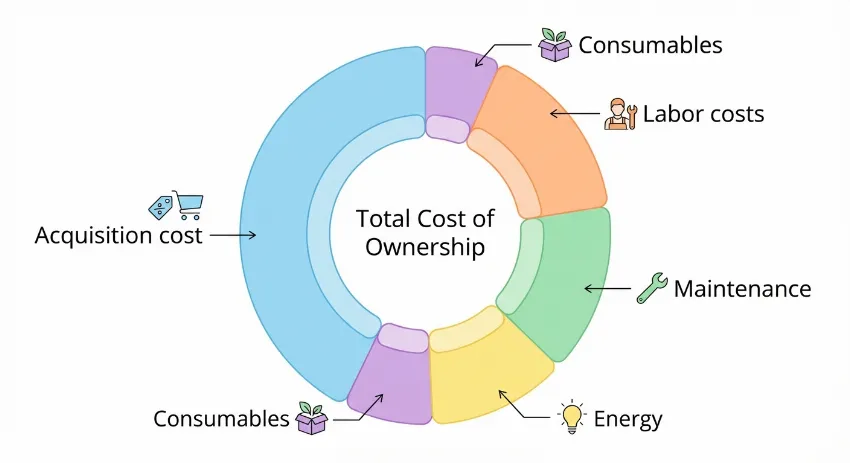
To perform an accurate baler ROI calculation, you must aggregate several distinct cost centers over the machine’s expected lifespan. TCO is not a static number; it is a dynamic formula that includes:
- Acquisition Cost: Purchase price, installation, and commissioning.
- Labor Costs: Operator time for feeding, tying, and moving bales.
- Maintenance: Spare parts (like shear blades), hydraulic servicing, and wear liners.
- Energy Consumption: Electricity usage per tonne of processed material.
- Consumables: Baling wire or strap costs.
By optimizing these variables—specifically labor and maintenance—an automatic system often proves cheaper in the long run. Research into industrial efficiency supports the notion that higher initial efficiency reduces long-term energy and operational burdens (Vir: OSTI).
Drastic labor savings: vertical vs. horizontal balers
The most significant variable in the ROI equation is human labor. Labor costs in the EU and other developed markets are rising. An investment in automation is essentially an investment in fixing your operational costs against future wage inflation.
The hidden costs of manual wire tying on vertical presses
Vertical balers are labor-intensive. For every bale produced, an operator must usually:
- Stop their current task.
- Walk to the baler.
- Manually thread the wires or straps through the bale.
- Tie off the bale securely.
- Eject the bale and reset the machine.
This cycle can take 10 to 20 minutes per bale. If a facility produces just six bales a day, that is up to two hours of lost productivity daily. Over a year, this adds up to hundreds of hours where staff are paid to tie knots rather than manage logistics or sort material.
Gains from automatic strapping and continuous feeding
In contrast, ANIS auto-tie channel balers operate continuously. The feeding conveyors, which we customize for every application, deliver material into the hopper without pause. When the bale reaches the correct length, the automatic wire tier engages and straps the bale in seconds without the ram stopping.
There is no human intervention required during the tying cycle. This allows the facility to run continuously, dramatically increasing daily throughput. High-efficiency machinery minimizes the “dead time” associated with older processing methods (Vir: Peanut Science Journal on Efficiency).
Quantifying forklift operator hours saved daily
Let us consider a practical scenario found in many Material Recovery Facilities (MRFs). With a manual system, the forklift driver is often also the baler operator. They are constantly getting on and off the forklift to manage the press.
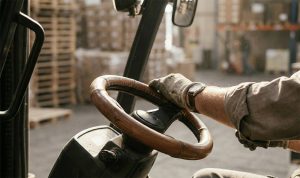
With a fully automatic ANIS baler integrated with a conveyor, the driver simply dumps the load onto the belt and drives away to fetch the next load. We estimate that in a busy facility, this saves approximately 4 hours of forklift operator time per day. This is time that can be redirected toward unloading trucks faster or organizing the yard, effectively increasing the facility’s capacity without hiring more staff.
Logistics efficiency and increased material revenue
ROI is not just about saving money; it is also about making more of it. The physical quality of the bale has a direct impact on your revenue stream.
Maximizing truck payloads with high-density bales
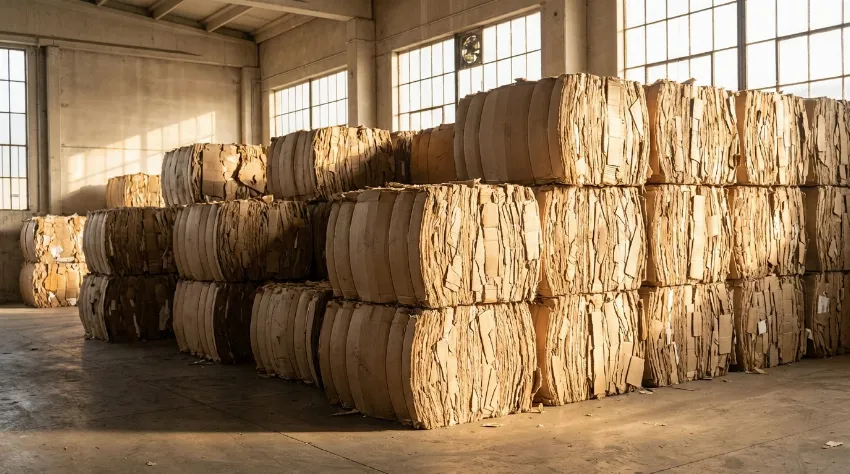
Transporting air is expensive. If your bales are loose or poorly shaped, you might only fit 18 to 20 tonnes on a standard truck. ANIS channel balers, with pressing forces ranging from 40 up to 205 tonnes, utilize sheer blades and pre-press flaps to maximize compaction.
Our machines produce high-density, stackable bales. This allows you to load trucks to their maximum weight limit (typically 24-25 tonnes). Reducing the number of trucks required to move your material by even 10% drastically cuts logistics costs over a year.
Commanding higher prices for premium mill-sized bales
Recyclers and steel mills prefer material that is predictable and easy to process. Dense, well-shaped bales are safer to stack and easier to inventory. Consequently, “mill-sized” bales produced by high-performance channel balers often command a premium price per tonne compared to loose or irregular bales from smaller vertical presses.
How bale density impacts storage and transport costs
Space is a finite resource in any recycling center. High-density bales take up less floor space for the same weight of material. This allows facilities to store more product indoors, protecting it from weather degradation, which is particularly important for paper and cardboard grades.
Running the numbers: a hypothetical baler ROI calculation
To demonstrate the financial logic, let us look at a hypothetical calculation for a mid-sized recycling center considering the switch from two vertical balers to one automatic ANIS channel baler.
Identifying key variables for your investment analysis
To customize this for your business, you need the following data points:
- Hourly Wage (fully burdened): e.g., €25/hour.
- Daily Production: Tonnes per day.
- Current Labor Hours: Time spent manually baling.
- Transport Cost: Average cost per truck trip.
Steps to perform a precise baler ROI calculation
The formula is relatively straightforward:
- Calculate annual labor savings (Hours saved × Hourly Rate).
- Calculate logistics savings (Reduction in truck trips × Cost per trip).
- Add revenue increase (Premium for better bales + value of increased throughput).
- Subtract the difference in energy and maintenance costs between the new and old systems.
- Divide the Total Machine Cost by the Annual Net Savings to find the payback period in years.
Estimating the payback period based on operational savings
Let us assume the automation saves 4 hours of labor per day at €25/hour. That is €100/day. Over 250 working days, that equals €25,000 in labor savings annually.
Additionally, if better bale density reduces truck trips by 15 per year at €500 per trip, that is another €7,500 saved.
Without even factoring in higher material prices, we have identified €32,500 in direct annual savings. For many businesses, these operational efficiencies mean the machine pays for itself well within the standard 3-5 year depreciation cycle, continuing to generate pure profit for the remainder of its 15-20 year life.
How ANIS Trend engineering improves long-term returns
Not all horizontal balers deliver the same ROI. The durability of the machine dictates maintenance costs and uptime. We build our machines with an “extra heavy construction” philosophy to ensure the calculation holds up over decades.
Reducing maintenance costs with Hardox wear plates
Friction destroys lesser machines. To combat this, ANIS balers feature changeable wear plates made of HARDOX material. This wear-resistant steel internal coating significantly extends the lifespan of the baler. Furthermore, our design uses bolted fixings for these plates, ensuring that when replacement is finally needed, it is quick and easy, minimizing maintenance downtime.
Impact of energy-efficient drives on daily expenses
Energy costs are a major component of TCO. We utilize compact hydraulic power packs with energy-efficient and noise-optimized main drives. By tailoring the power unit to individual customer requirements, we ensure you are not paying for electricity you do not use to generate necessary pressing force.
The value of multi-material flexibility for sorting plants
Finally, flexibility protects your investment. Markets change; today you might process cardboard, tomorrow PET or aluminum cans. ANIS balers offer unique multi-material capability. With options like Preflap & Shear technologies, and adjustable recipe management via our Siemens PLC controllers, you can switch materials frequently without compromising bale quality. This adaptability ensures your asset remains productive regardless of market fluctuations.
Summary

While the upfront cost of an automatic channel baler is higher than manual alternatives, the math supports the investment for growing businesses. By drastically reducing labor hours, optimizing transport logistics, and ensuring low maintenance through robust construction like Hardox wear plates, the Total Cost of Ownership is significantly lower over the machine’s life. At ANIS Trend, we help you navigate these numbers to find the solution that maximizes your long-term profitability.
Frequently Asked Questions (FAQ)
1. Does a horizontal baler always use more electricity than a vertical one?
While the motors are larger, the throughput is much higher. On a per-tonne basis, a modern, energy-efficient ANIS channel baler is often very comparable or even more efficient because it runs continuously rather than starting and stopping constantly.
2. Can ANIS balers handle different materials without changing parts?
Yes. Our balers are designed for multi-material use. With our optimally adjusted software and recipe management system, you can switch between materials (e.g., from cardboard to plastics) quickly via the Touch Panel, guaranteeing high bale quality for each type.
3. How often do the wire tying systems need maintenance?
The ANIS horizontal wire tie system is designed for easy cleaning and operator safety. While regular inspection is part of standard maintenance, our robust design minimizes faults. In 95% of cases, any issues can be rectified quickly through our support services.
4. What happens if the waste material is very abrasive?
We equip our balers with changeable HARDOX® wear plates. These are bolted for easy replacement. This design specifically targets abrasive environments to ensure the main structure of the baler remains undamaged.