


A horizontal baler is a heavy-duty compaction machine designed to continuously process large volumes of loose waste materials into dense, stackable blocks for transport. Facilities handling significant daily tonnages rely on these systems to reduce landfill expenses, optimize truck payloads, and transform loose scrap into sellable commodities. Before analyzing complex throughput specifications and hydraulic configurations, it helps to understand what a baler does; you can also review what is an industrial baler to establish a baseline.
What is a horizontal baler machine?
A horizontal baler machine is an automated industrial compaction system that uses a horizontal hydraulic ram to compress high volumes of waste material into dense bales. It operates continuously, typically fed by conveyors, and utilizes automatic wire-tying systems to secure the compacted material for efficient transport and recycling.
Most industry literature stops at explaining that horizontal equipment produces mill size bales. This guide details the mathematics of sizing a machine, the taxonomy of compaction architectures, and the direct link between mechanical specifications, bale quality, and eventual price per tonne at the paper mill or foundry.
How does a horizontal baler work?
A horizontal baler works by utilizing a main hydraulic cylinder to drive a pressing ram forward, horizontally forcing loose material from a feeding hopper into a reinforced bale chamber. Once the material reaches a predetermined length and compaction density, the system engages a tying mechanism to wrap the block in steel wire before extruding it out of the machine. The continuous nature of this process allows sorting lines to feed material without interruption.
The operational sequence begins with the feed hopper, which accepts bulk loads from integrated conveyor belts, tipping devices, or air transport systems. As the material drops into the compaction zone, shear blades mounted on the ram and the frame cut any excess material bridging the hopper opening. The hydraulic power pack drives the ram forward, compressing the material. In continuous systems, the ram retracts, allowing more material to fall, and repeats the cycle. This repetitive action defines the machine’s duty cycle and overall hourly performance.
In our practice designing complete equipment solutions for communal and industrial waste management, we observe that operators who align their feed conveyor speeds precisely with the baler’s hydraulic cycle times achieve the highest consistent throughput.
The four architectures and what each is for
Selecting the correct pressing technology depends entirely on your business model and the specific fractions you process. A comprehensive horizontal vs vertical baler comparison demonstrates that once a facility exceeds a certain manual handling threshold, upgrading to a horizontal system is inevitable. However, horizontal machines are categorized into distinct structural designs.
Closed end horizontal balers
Closed end horizontal balers operate by compacting material against a heavy steel door that remains shut during the entire pressing cycle. Once the bale achieves maximum density, the operator opens the door, manually or semi-automatically ties the bale, and uses the ram to eject it. These machines are optimal for processing highly expansive materials like memory foam, rubber, or specific plastics where continuous extrusion fails to hold the material structure.
Open end auto-tie channel balers
An open end auto-tie channel baler operates without a front door, instead using the friction of the previously compacted material in a long extrusion channel to provide resistance for the next bale. As the hydraulic ram pushes new material into the channel, it forces the entire plug of material forward. When the target length is met, the horizontal wire tie system automatically inserts and twists steel wires around the bale.
This architecture is the industry standard for Material Recovery Facilities (MRFs) and large distribution centers because it allows for uninterrupted, fully automatic running. The automated tying significantly reduces labor requirements and improves operator safety by eliminating the need for manual wire feeding.
Single ram and two ram balers
Single ram balers utilize one primary hydraulic cylinder for compaction and extrusion, while two ram balers use a gathering ram to push material against a wall, followed by a secondary extrusion ram acting at a 90-degree angle to eject the bale through the tying tier. The choice dictates how the machine handles material memory and shear force.
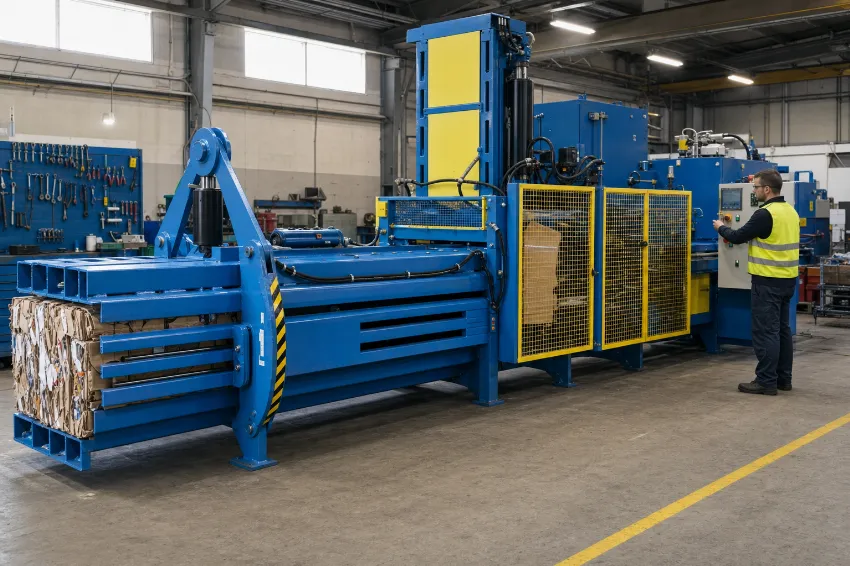
Many manufacturers strictly advocate one specific technology. ANIS offers all options, including Preflap & Shear technologies, to handle the widest possible range of materials. We implement cutting (shear) presses for specific fractions, while our pre-press units utilize either a single flap or double lateral flaps. A pre-press with a big single flap excels with materials like PET and plastic film, preventing material from wrapping around shear blades. Conversely, high throughput requirements often make a press with double lateral pre-press flaps the best option for preventing bridging in the hopper.
| Architecture | Best suited for | Throughput | Tying |
|---|---|---|---|
| Closed end | Highly expansive materials (memory foam, rubber, certain plastics) | Moderate; door opens each cycle | Manual or semi-automatic |
| Open end auto-tie channel | MRFs and large distribution centres running mixed recyclables | Highest; continuous extrusion | Automatic steel wire |
| Single ram | General compaction where one press stroke handles feed and extrusion | High | Automatic, inline |
| Two ram | Materials with high memory or shear resistance needing a separate gathering stroke | High | Automatic, at 90 degrees to the gathering ram |
How many tonnes per hour do you actually need?
Determining the correct machine capacity requires translating your raw volume data into required hourly throughput, factoring in peak loads and material behavior. Before executing these calculations, some operators review vertical baler specifications only to realize their monthly tonnages demand horizontal continuous processing.
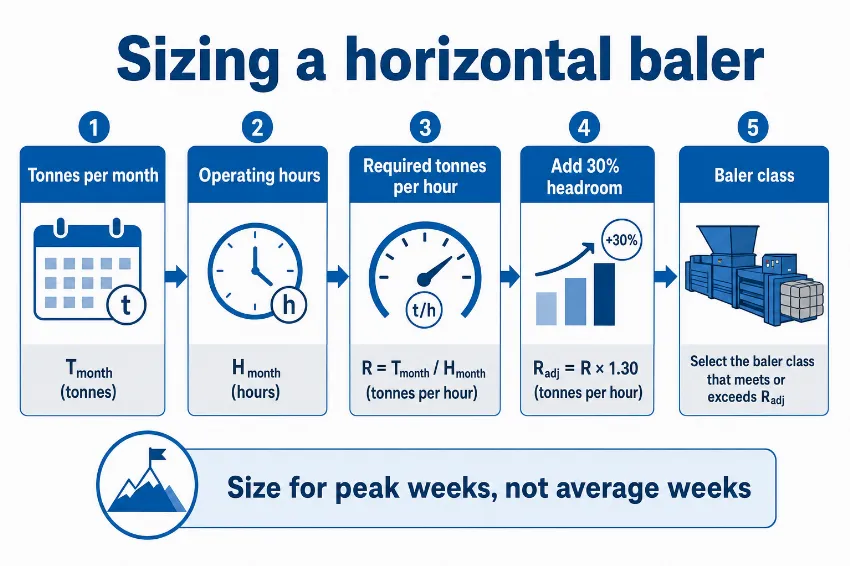
Converting monthly tonnage into required throughput
Calculating your required throughput involves converting loose monthly volumes into a daily and hourly target, then applying a surge multiplier. Taking the average hourly volume is insufficient because MRF sorting lines deliver material in inconsistent bursts.
- Determine daily volume: Divide your total monthly tonnage by the number of operational days (e.g., 1,200 tonnes / 20 days = 60 tonnes per day).
- Calculate operational hourly average: Divide the daily volume by active processing hours, excluding breaks and maintenance (e.g., 60 tonnes / 7 hours = about 8.6 tonnes per hour).
- Apply the peak surge multiplier: Multiply the hourly average by a minimum of 1.5 to account for conveyor surges and seasonal spikes. In this scenario, the facility requires a baler capable of at least 13 tonnes per hour.
The loose bulk density of your specific material dramatically impacts how quickly the machine reaches that tonnage. For example, processing 10 tonnes of unflattened cardboard requires significantly more cubic meters of hopper space and ram strokes than processing 10 tonnes of heavy magazine paper.
What decides bale weight and density
Bale weight and ultimate density are determined by the interaction between hydraulic force, the material’s natural expansion rate, and the dimensions of the compaction chamber. High specific pressing forces result in heavy, well-shaped bales that stack securely in transport vehicles.
Ram face pressure is the total hydraulic force exerted divided by the surface area of the compaction platen. This metric dictates the final bulk density of your bales and their ability to maximize shipping container weight limits.
Machines generating pressing forces from 40 up to 205 tonnes handle different material resistance profiles. A metal baling press, such as an ANIS Small Format Can Baler with a robust press-ram, uses high pressure to overcome the rigid structure of used beverage cans (UBC) and steel cans, producing dense 40 x 40 cm packets without the need for bale ties.
Space, power and installation requirements
Integrating a channel baling press into an existing sorting plant requires analyzing floor space, ceiling height for feed conveyors, and electrical infrastructure. These machines are built with extra heavy construction to withstand continuous vibration, necessitating a reinforced concrete foundation capable of supporting 15 to 35 tonnes of static weight plus dynamic operational loads.
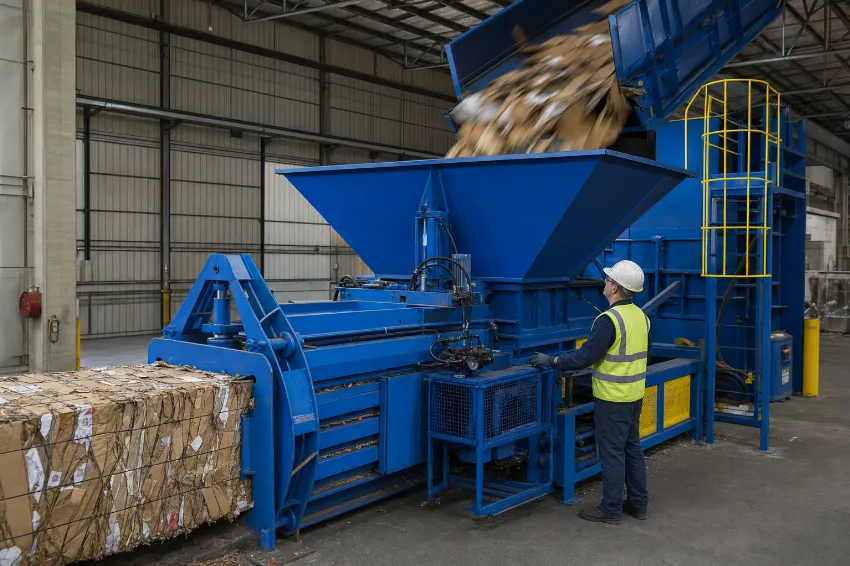
The very compact construction of a baler results in a significant space reduction, but ample clearance must remain for wire spool replacement, automated tipping devices, and forklift access for bale removal. The power pack requires a dedicated electrical feed. We equip our machines with an electrical system protected by double contact breaker isolation, providing a high level of safety and stable power draw.
This rule applies in most cases, except when integrating high-capacity feed systems in historical industrial buildings with severe structural constraints; here, we must split the power unit from the main frame and utilize a customized low-profile hopper to bypass standard clearance requirements.
From machine spec to bale spec to price per tonne
The mechanical capabilities of your baler directly influence your revenue. Paper mills, foundries, and plastics recyclers purchase multi-material bales based on strict acceptance specifications regarding density, shape, and contamination levels. Software optimally adjusted for different materials ensures high bale quality even when the material stream on the conveyor frequently changes.
What is a mill size baler?
A mill size baler is a horizontal baler that produces bales sized, weighted, and compacted to meet the acceptance specification of a receiving paper mill or reprocessor. There is no single universal standard: each mill sets its own minimum weight, dimensions, and density, so the same machine can run several mill size formats.
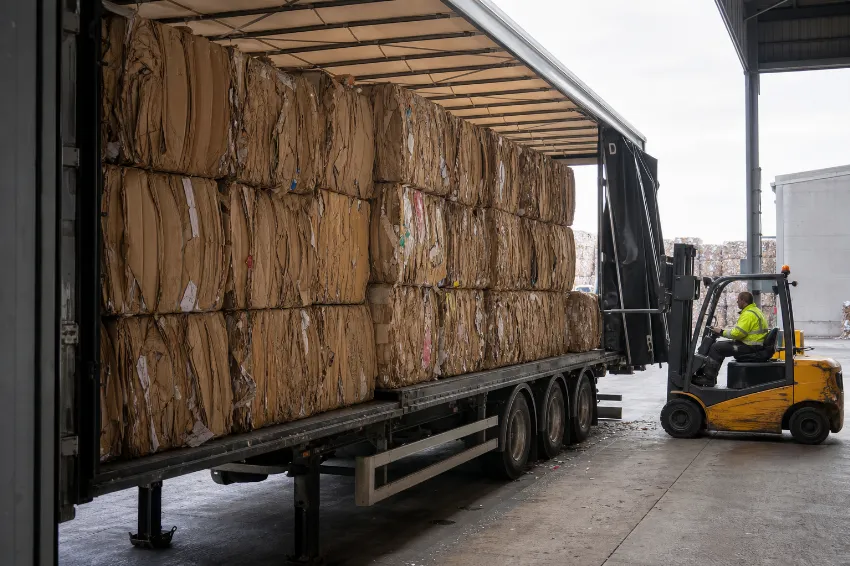
In European and UK markets, a mill size cardboard bale is generally expected to weigh at least 400 to 500 kg and measure close to 120 x 100 x 80 cm, which lines up with the largest channel formats listed below. “To be classed as a mill size bale, a bale of cardboard must weigh no less than 400 kg” (Source: QCR). Producing bales at this size lets recyclers ship full mill-specification loads without reprocessing, which is why continuous open end channel presses are the usual choice when mill size output is the goal.
Moisture content and material prohibitives are closely monitored by buyers. A dense, structurally sound mill size bale resists water absorption during open-air storage far better than a loosely compacted block. “ReMA’s ISRI Specifications Guidelines for Paper Stock (PS-2026) set 12 percent as the maximum dry moisture limit for paper stock” (Source: Recycled Materials Association). Bales exceeding this limit face severe downgrades or total rejection at the mill.
Optimized bale dimensions (such as four standard channel sizes: 750 x 750 mm, 800 x 1000 mm, 1100 x 750 mm, and 1100 x 1100 mm) ensure efficient full truck loading. Maximizing payload weights per transport dramatically reduces logistics costs, thereby increasing your net margin per tonne of processed secondary raw materials.
Safety standards you are buying into
Procuring a heavy industrial machine mandates adherence to stringent international safety and quality standards. Operator protection during maintenance, clearing jams, and daily operation is non-negotiable. Machines must comply with the CE requirements, and ANIS is certified to ISO 9001:2015.
Standard safety integrations include:
- Enclosed constructions providing a maximum level of safety against flying debris.
- Feeding hoppers equipped with lateral secured polycarbonate glass doors for safe visual inspection.
- Horizontal wire tie systems that allow cleaning from the side, keeping operators out of the hazard zone.
- Key-trap systems and emergency stop circuits governing the main drives.
Facility managers must also align their operations with regional safety mandates. Detailed guidelines on baler operation safety and energy isolation protocols are accessible through OSHA. Additional European machine safety parameters are documented under standards like DIN EN 16252, which dictates safety requirements for baling presses.
Service life and what it costs to keep
The capital expenditure for an industrial horizontal baler represents a long-term infrastructure investment. Calculating the total cost of ownership (TCO) requires projecting maintenance schedules, spare parts consumption, and energy efficiency over a decade or more.
“Industry operators cite 12 to 15 years as the ideal service lifespan for a baler, depending on wear and tear” (Source: Recycling Today).
To extend durability beyond this average, construction materials are critical. ANIS machines utilize HARDOX wear-resistant steel internal coatings. The changeable HARDOX wear plates feature bolted fixing, ensuring easy and quick replacement without cutting and welding. The core mechanical longevity relies on using the best available components, including high-quality hydraulic cylinders with hard-chromed rods from the Austrian company Dorninger, and PLC controllers from SIEMENS.
In our 25 years of developing auto-tie channel presses, we observe that operators who maintain strict preventative schedules for replacing multiple blade segments, designed to turn cutting edges two times to reduce spare parts costs, experience significantly lower hydraulic strain. For operators assessing older equipment, checking the machine against a baler maintenance checklist and comparing its running costs in a total cost of ownership analysis is critical before upgrading.
Familiarizing your maintenance team with a comprehensive baler parts guide ensures faults can be quickly rectified. Intelligent technologies and modern Touch Panel recipe management allow technical teams to resolve around 95% of issues through telephone-based service.
Summary and sizing proposal
Selecting a horizontal baler requires matching machine architecture, whether shear, single flap, or double lateral flaps, to your specific material streams and facility constraints. By accurately calculating your required throughput and prioritizing robust construction features like HARDOX wear plates and advanced hydraulic systems, facilities can achieve optimal bale density, maximize truck payloads, and secure the highest possible market price for their recycled commodities.
Send your tonnage and material mix to ANIS for a sizing proposal. Our engineering team will analyze your operational data and recommend a customized, high-performance compaction solution tailored to your facility’s exact requirements.
Frequently asked questions
How much space is needed for a channel baling press?
A channel baling press requires a substantial footprint, typically ranging from 8 to 15 meters in length, depending on the extrusion channel and feeding conveyor. You must also account for vertical clearance for the feed hopper and sufficient operational space for forklifts to maneuver and load the extruded bales safely.
What is an auto-tie baler?
An auto-tie baler is a continuous-operation compaction machine equipped with a specialized mechanical tier that automatically threads, cuts, and twists steel wire around the compacted material. This automated process eliminates the need for manual tying, drastically increasing the hourly throughput and safety of the sorting facility.
How long does an industrial horizontal baler last?
An industrial horizontal baler generally lasts between 12 and 15 years under heavy daily use, provided it receives standard preventative maintenance. Machines built with replaceable HARDOX wear plates and premium hydraulic cylinders often exceed this lifespan, retaining high pressing force and reliability for many years.