


You are standing in the middle of a material recovery facility looking at a 500-kilogram cardboard bale, only to realize a small amount of machine grease and a few hidden plastic layers have just downgraded the entire load from premium material to mixed waste. Knowing exactly how to prepare cardboard for baling determines whether recycling mills pay top market rates for your materials or reject the truckload entirely. Facility managers constantly search for ways to increase throughput, but without proper upstream preparation, even the most powerful compaction equipment cannot salvage contaminated fibers. Establishing a rigorous preparation routine is the core of our efficient waste sorting guide, ensuring fiber purity and maximum profitability.
How do you prepare cardboard for baling?
To prepare cardboard for baling, remove all contaminants such as plastic wrap, styrofoam, and excessive food residue, keep the material completely dry, and separate clean corrugated boxes from mixed paper grades. Proper sorting and preparation ensure maximum fiber purity, higher bale density, and prevent load rejections at the recycling mill.
Why bale quality starts before compaction
In our 25 years of manufacturing baling presses at ANIS, we observe that facility operators often blame their baler for poor bale integrity or mill rejections, when the actual issue lies entirely in upstream material preparation. A baler simply compresses whatever enters the hopper. If the feed includes unflattened, highly contaminated, or wet materials, the resulting bale will reflect those poor characteristics. High specific pressing forces, which in our channel balers reach up to 205 tonnes, will tightly bind contaminants right alongside valuable fibers, making downstream separation nearly impossible.
Recycling mills operate on strict tolerance levels for impurities. A single bale containing excessive non-paper elements can compromise an entire pulping batch. When mills detect high levels of contamination, they impose financial penalties or reject the entire load, forcing the sorting facility to bear the transportation and landfill costs. Understanding how cardboard is recycled and baled highlights why securing fiber purity before the material ever touches the feed conveyor remains the most critical step in waste management.
Sort by grade before you bale
Effective waste segregation requires distinguishing between different grades of paperboard. Throwing every type of paper product into the same pile drastically reduces the value of the final bale.
OCC (Old Corrugated Containers) is a specific grade of recyclable paperboard characterized by a fluted corrugated medium sandwiched between two flat linerboards. It commands a significantly higher market price than mixed paper grades because its long, strong fibers can be recycled multiple times.
Operators must train their floor staff to separate premium OCC from folding cartons, office paper, and newspaper. Mixing these grades lowers the overall classification of the bale to the lowest common denominator. Dedicated sorting lines handle this separation efficiently, ensuring that only pure corrugated board reaches the baler hopper. The scale of this stream is substantial: in 2018, corrugated boxes achieved a 96.5 percent recycling rate in the United States (Source: US EPA).
The contaminants that get bales rejected
Mill rejections rarely happen without a clear cause. Identifying and eliminating specific contaminants before they enter the baling chamber protects your return on investment and maintains strong relationships with buyers. Knowing what materials can be recycled together is a fundamental requirement.
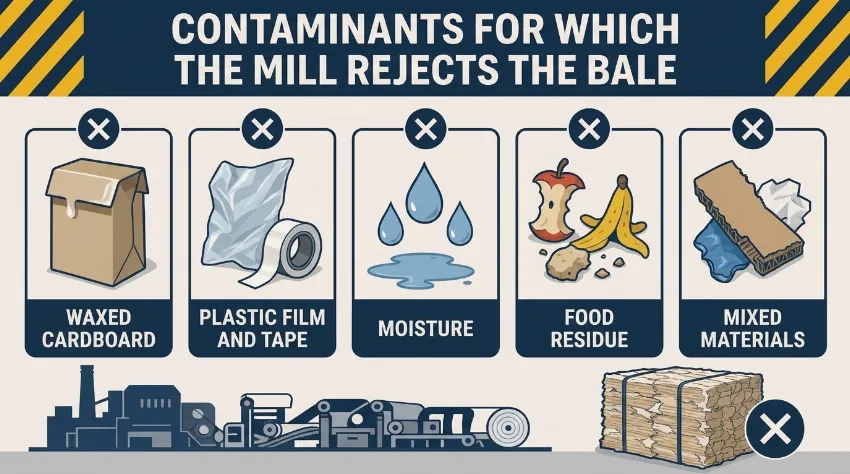
| Contaminant type | Impact on bale quality | Required action before baling |
|---|---|---|
| Styrofoam & plastic wrap | Does not break down in the pulper; it must be screened out and raises the mill’s reject rate. | Complete removal from boxes during sorting. |
| Chemicals & grease | Prevents fibers from bonding and leaves spots in the new paper; heavily soiled board lowers the grade of the whole bale. | Discard affected cardboard into general waste. |
| Glass & metals | Poses safety risks and damages mill equipment. | Strict mechanical or manual segregation required. |
Wax-coated and plastic-lined board
Cardboard used for transporting fresh produce or frozen goods often features a thin wax or polyethylene coating to resist moisture. These coatings do not break down in standard pulpers. If mixed into an OCC bale, they create dark spots and structural weaknesses in the recycled paper products. Floor teams must manually identify and divert coated boxes away from the main corrugated stream. This rule applies in most cases, except when you are baling material strictly for a specialized pulping facility that explicitly accepts poly-coated cartons; otherwise, these materials will cause a standard OCC load to be rejected.
Moisture, tape and food residue
Standard packing tape generally poses less of a problem than heavily plasticized strapping or reinforced duct tape. While modern recycling mills use screens to filter out small amounts of standard acrylic tape, operators should still remove large strips of heavy-duty plastic tapes and strapping bands. Food residue, particularly oil and grease found in pizza boxes, coats the paper fibers and prevents them from binding with water during the recycling process. Any section of cardboard heavily saturated with grease must be cut out or discarded entirely to protect the purity of the bale.
How to keep cardboard dry and stack it safely
Moisture content dictates both the weight and the structural integrity of a bale. Cardboard acts like a sponge, absorbing humidity from the air and water from the ground. When wet material enters a channel baler, the compression forces squeeze the water out of the chamber, creating a slipping hazard around the machine and extra wear on the press. Furthermore, wet fibers lose their tensile strength.
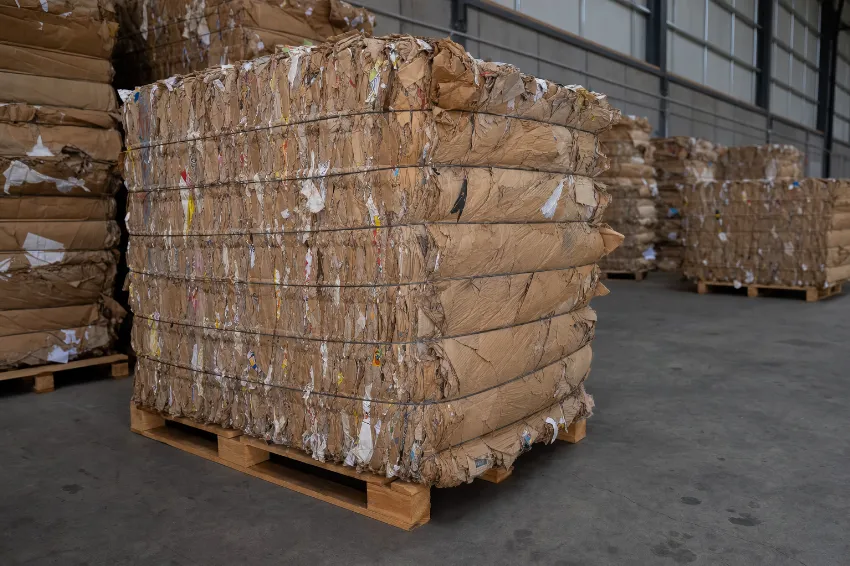
From installing over 350 different systems worldwide, we know that pressing wet cardboard severely degrades bale integrity and leads to wire snapping as the material dries and shifts unevenly during transport. High moisture levels also promote mold growth and rot within the center of the bale, rendering the fibers useless to buyers. Facilities must store loose cardboard indoors or under heavy tarps, keeping it elevated on pallets away from pooling water.
How to prepare cardboard for baling: a simple workflow for your team
Consistency on the facility floor ensures high bale quality even when material is frequently changed. Implementing a standardized workflow reduces human error and accelerates the feeding process. Plant managers aiming to process recyclable materials for profit should implement these specific operational steps:
- Initial visual inspection: Stage incoming loads in a well-lit area. Have staff immediately pull out heavily soiled, greasy, or wax-coated boxes.
- Contaminant stripping: Remove all styrofoam inserts, plastic film wrap, and heavy metal strapping from the boxes.
- Grade separation: Route pure OCC to the primary feed conveyor while diverting mixed paper to a secondary storage area.
- Moisture check: Reject any bundles that have been exposed to rain or standing water.
- Controlled feeding: Use an automated tipping device or a custom-designed feed hopper to ensure a steady, even flow of material into the baler, preventing jams and maximizing the efficiency of the shear blades.
Summary of effective material preparation
Optimizing your waste management processes requires strict attention to material handling before compaction begins. Removing contaminants like plastic coatings, styrofoam, and heavy food residue protects fiber purity and supports higher market prices. Keeping materials dry prevents mechanical issues and bale wire failures, while separating pure OCC from mixed grades ensures the final product meets mill specifications. A well-trained sorting team working alongside a robust channel press delivers heavy, well-shaped, and stackable bales for optimal truck loading.
Frequently asked questions
Why do mills reject cardboard bales?
Mills reject bales primarily due to high levels of contamination from plastics, wax coatings, styrofoam, or excessive moisture. When non-paper materials enter the pulping process, they damage machinery and degrade the quality of the new paper being produced.
Do I need to remove all packing tape before baling?
You do not need to remove every piece of standard paper or thin acrylic packing tape, as modern pulpers can screen small amounts out. However, you must remove heavy plastic strapping, duct tape, and large reinforced tapes to maintain high fiber purity.
Can wet cardboard be baled safely?
Baling wet cardboard usually leads to severe operational problems, including compromised bale integrity and snapped wire ties as the material dries and shifts. Moisture also causes the fibers to rot and mold, drastically reducing the resale value of the bale.
Are you looking to optimize your recycling facility with equipment designed to handle specific material grades? Contact ANIS Trend to explore our customized baling presses, feed conveyors, and sorting systems. Our team will help you build a solution that improves your bale quality, reduces rejection rates, and maximizes your operational profitability.