


You are standing in a recycling facility looking at stacks of newly compacted material, trying to calculate if you have enough tonnage to fill a standard transport truck. If you miscalculate the mass of your compacted materials, you either ship half-empty trailers or face overweight transport fines. Understanding exactly how much a bale weighs is the foundational metric for profitable and efficient waste management.
Operators frequently look at the physical size of a compacted block and assume its mass is standard across the board. Reality in the sorting line dictates otherwise. A cubic meter of compacted hollow plastic bottles behaves entirely differently under hydraulic pressure than a cubic meter of flat paperboard. With over 25 years of experience developing and manufacturing auto-tie channel bale presses at our headquarters in Slovenia, we observe that facilities often struggle with logistics simply because they fail to match their specific material flow to the correct baler and compaction technology.
How many bales make a ton?
The number of bales required to make one metric ton depends entirely on your machine and material. For standard vertical balers producing 250 kg cardboard bales, you need four bales per ton. With high-density mill-size channel balers producing 500 kg bales, just two bales equal a ton.
What determines the weight of a bale
A bale’s final weight is determined by four primary variables: the physical characteristics of the processed material, the internal volume of the pressing chamber, the material’s moisture content, and the specific pressing force applied by the machine’s hydraulic cylinders.
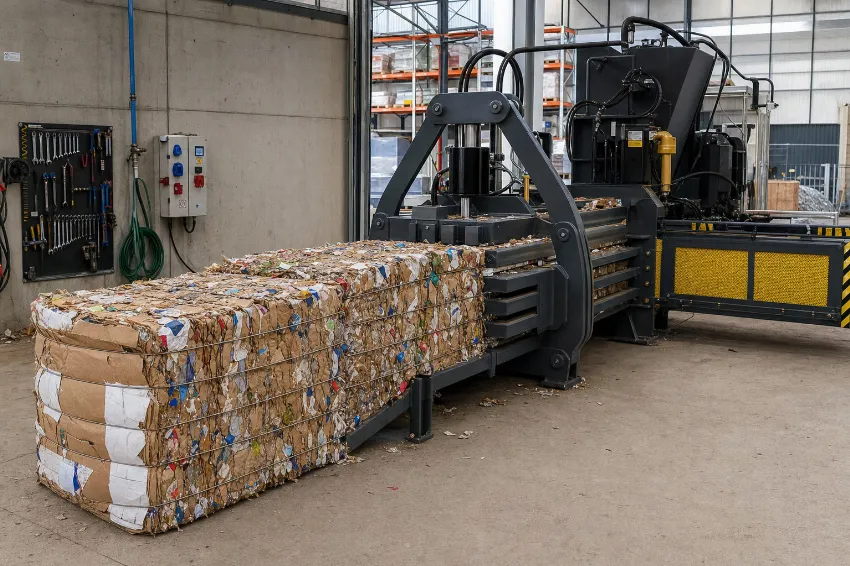
Bale density is the measurement of compacted mass per unit of volume, typically expressed in kilograms per cubic meter. High bale density directly correlates with heavier, structurally sound blocks that maximize payload capacities for long-distance transport vehicles.
To accurately predict the mass exiting your sorting line, you must evaluate the following components:
- Pressing force: Compaction power dictates how tightly material fibers interlock. Our ANIS balers apply pressing forces ranging from 40 up to 205 tonnes to handle the widest possible range of materials.
- Material memory: Plastics like PET have a high “memory” and want to expand back to their original shape after the press ram retracts, resulting in a lighter block compared to flat paper.
- Moisture levels: Wet materials weigh significantly more than dry ones. While a wet block is heavier, excessive moisture degrades cardboard quality and leads to rejection at paper mills.
- Pre-press technology: The choice between shear (cutting) blades, a pre-press with a single flap, or double lateral flaps drastically alters how much raw material is forced into the main chamber before the final stroke.
How much does a cardboard bale weigh?
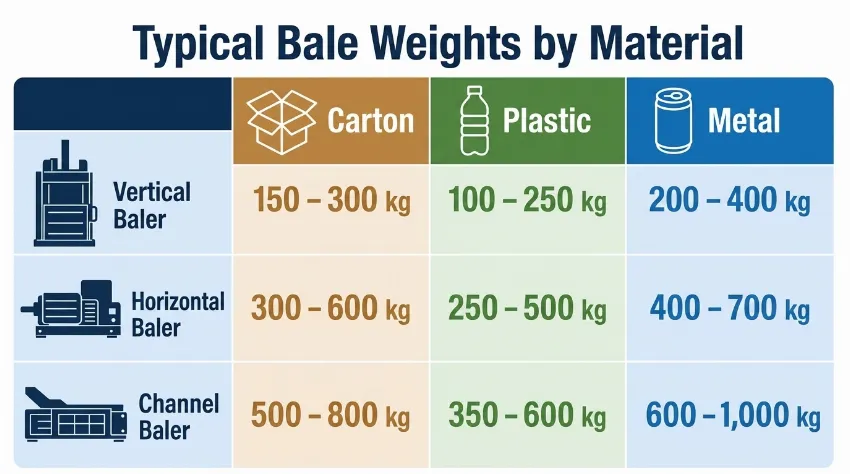
A standard cardboard bale weighs anywhere from 50 kg in small retail compactors to well over 800 kg when processed through heavy-duty industrial channel balers. Cardboard is highly compressible because its corrugated structure collapses easily under pressure, removing trapped air efficiently.
According to official industry data, corrugated boxes had a recycling rate of 96.5 percent in 2018 (Source: US EPA). Managing this massive volume requires precise equipment calibration. Because cardboard fibers bind together well, maintaining optimal bale dimensions and weights ensures efficient full truck loading without structural collapse.
Vertical baler bale weights
Vertical machines are typically found in supermarkets, distribution centers, and retail environments where floor space is heavily restricted. Because they operate with lower hydraulic pressure and feed volumes, the output is lighter.
A small footprint vertical baler will produce blocks weighing between 50 kg and 100 kg. Mid-sized vertical machines push these numbers up to a range of 200 kg to 350 kg. These packages are usually tied manually and moved with standard pallet jacks, making them a practical solution for low-volume waste generators who do not require automated sorting lines.
Mill-size horizontal baler bale weights
Facilities handling high volumes of secondary raw materials rely on horizontal channel balers to produce “mill-size” blocks. These are specifically calibrated to fit side-by-side inside standard transport trailers.
A mill-size cardboard bale processed through robust auto-tie channel balers that make mill-size bales generally weighs between 400 kg and 850 kg. To achieve these numbers consistently, operators focus on optimizing cardboard baler bale density. Our machines utilize heavy construction and specialized hydraulic cylinders made by the Austrian company Dorninger to deliver heavy, well-shaped, and stackable output even when the material flow fluctuates.
How much does a plastic bale weigh? PET, film and HDPE
A plastic bale typically weighs between 200 kg and 600 kg, depending entirely on whether the machine is compressing rigid HDPE containers, hollow PET bottles, or flexible stretch film. Unlike cardboard, plastic fractions require specific machine setups to achieve maximum compaction.
PET bottles present a unique challenge. Because they contain trapped air and have high material memory, they resist compaction. Without the right technology, a PET block might only weigh 250 kg. To combat this, we often recommend a pre-press method with a single big flap, which forces the plastic down into the chamber efficiently before the main ram extends. Conversely, thick plastic film can be compacted into much heavier blocks, often reaching 400 kg to 500 kg.
When selecting a plastic baling machine, it is critical to understand that most manufacturers offer only one specific technology: some strictly advocate pre-compacting with a single big flap, while others push double lateral flaps. We provide all options, including four channel sizes (from 750 x 750 mm up to 1100 x 1100 mm), to adapt exactly to your specific polymer fractions.
How much does a metal bale weigh?
A metal bale typically weighs between 20 kg for small, highly dense briquettes made from edge trims, up to 500 kg or more for larger packages of tin or aluminum packaging. Metal is a valuable fraction in MRFs (Materials Recovery Facilities) and demands highly specialized equipment to process.
The ANIS Small Format Can Baler is designed specifically as a front-door-working fully automatic can crusher. The final product from this machine is a small and very dense block with sizes of 40 x 40 x (10-30) cm. Despite their small dimensions, these blocks are very heavy due to the high specific pressing force, making them suitable for direct use by foundries and steel mills.
This wire-tying rule applies in most cases, except when processing used beverage cans (UBC) or steel cans through our scrap presses, where solid material compaction creates a dense package that holds itself together without the need for bale ties. This enclosed construction provides a maximum level of safety while reducing consumable operating costs.
Why bale weight decides your revenue and logistics
The mathematics of waste transport are straightforward: logistics companies charge per trip, not per ton. If your compacted output is too light, you will physically fill the volume of a standard 13.6-meter trailer long before you reach its maximum payload of approximately 24 metric tons.
Shipping air is the fastest way to erode profitability in recycling operations. Highly compacted and stackable packages for optimal truck loading are the best proof of the efficiency of channel balers. For example, if your blocks weigh 300 kg each, a truck loaded with 40 units will only carry 12 tons. By increasing that individual mass to 600 kg, you double your payload on the exact same truck journey, halving your transport costs per ton. Our guide to high bale density and transport costs runs this calculation in more detail.
Understanding how to select a channel baler directly impacts this equation, because chamber size, pressing force and pre-press technology together decide how close each trailer gets to its weight limit.
How to increase bale weight safely
Achieving a higher density requires a combination of correct machine specification, optimal feeding, and routine maintenance. Pushing machinery beyond its engineered capacity leads to rapid wear and catastrophic hydraulic failure.
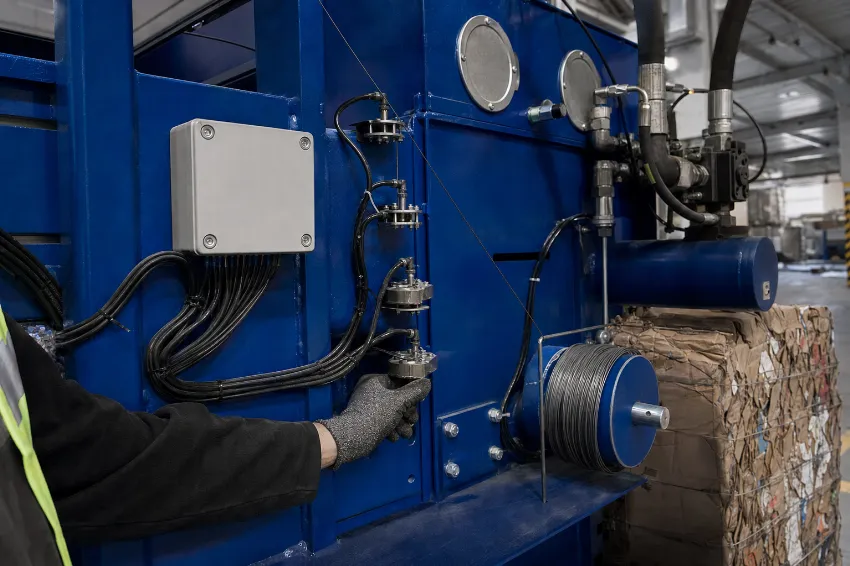
To safely increase the mass of your compacted output, implement the following operational adjustments:
- Implement optimal feeding systems: Ensure the feed hopper is designed to suit the application, whether bulk loaded, integrated with a conveyor, or fed by an air transport system. A consistent feed prevents hollow spots inside the chamber.
- Maintain shear blades: The highest load material in the hopper is sheared by replaceable blades. Using multiple blade segments allows operators to turn cutting edges two times, maintaining clean cuts while reducing spare parts costs.
- Utilize software recipe management: The PLC controller (from SIEMENS) allows software to be optimally adjusted for different materials. This keeps bale quality high even when the sorted fraction is frequently changed.
- Upgrade wear surfaces: Compacting abrasive materials degrades chamber walls, reducing friction and density. Using changeable HARDOX® wear-resistant steel internal coatings ensures an increased lifetime and maintains tight tolerances.
Summary of your optimal baling strategy
Determining exactly how much a bale weighs is the first step toward optimizing your entire sorting and logistics operation. Whether you are dealing with 500 kg cardboard blocks, resilient PET plastics, or highly dense can bales, the mass of your final product directly dictates your transport profitability. By matching the correct pre-press technology, pressing force, and hopper design to your material flow, you ensure maximum payload efficiency on every truck that leaves your facility.
Are you looking to optimize your transport costs with heavier, perfectly shaped, and stackable bales? Contact our expert team at ANIS Trend to calculate the appropriate baling system for your exact material flow and volume, and request a customized quote tailored to your individual requirements.
Frequently asked questions
How many mill-size bales fit on a standard transport truck?
You can typically load between 40 and 44 mill-size bales onto a standard European 13.6-meter trailer. The exact number depends on the cross-section dimensions (e.g., 1100 x 1100 mm) and whether the machine produces square, stackable output.
Why do my cardboard bales weigh less than the machine’s specification?
Bale weights often fall below factory specifications due to poor material feeding, low moisture content, or worn hydraulic components. The specifications state theoretical maximums under optimal conditions with a continuous, dense feed via conveyor belts.
Can I use the same machine for cardboard and metal cans?
While multi-material channel balers exist and handle a wide variety of fractions, processing metal generally requires specialized equipment. Metal processing plants use specific scrap presses equipped with HARDOX® wear plates to prevent severe abrasion that would quickly ruin a standard paper baler.