


In the competitive world of waste management, the efficiency of your logistics directly dictates your profitability. We understand that transporting “air” inside loose bales is one of the most significant, yet avoidable, expenses for recycling centers and industrial facilities.
At ANIS Trend, our philosophy has always been “Baling solutions driven by experience.” We know that achieving the highest possible bale weight per cubic meter is not just a technical specification; it is a financial necessity. To see how we achieve this through engineering, you can explore our range of channel baling presses designed for maximum compaction.
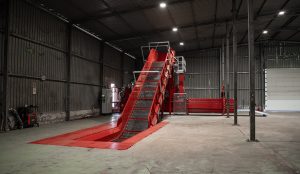
When processing corrugated cardboard and paper, the challenge lies in overcoming the material’s natural memory and elasticity. Optimizing cardboard baler bale density requires a synergy of high specific pressing force, intelligent channel design, and precise retention mechanisms.
How does cardboard baler bale density impact transport costs?
Increasing bale density directly reduces the cost per tonne of transported material. By achieving higher compaction, you fit more weight into the same cargo space, reducing the total number of truck movements required. For example, increasing density by just 10-15% can eliminate dozens of transport trips annually, significantly lowering fuel expenses and carbon footprint.
The direct link between bale density and transport economics
The economics of recycling are inextricably linked to logistics. The margin on secondary raw materials is often thin, meaning the cost of moving material from the baler to the paper mill can make or break a contract.
Reducing the number of trucks on the road
Every truck that leaves your facility represents a fixed cost, regardless of the weight it carries. Fuel, driver wages, and toll charges remain constant.
If your bales are loosely compacted, you might fill the volume of the trailer long before you reach its weight limit. We have seen operations where improving bale density allowed for a reduction in fleet requirements by up to 20%.
Fewer trucks on the road also means less traffic management at your facility. This leads to streamlined operations and reduced waiting times for loading.
Maximizing payload weight for full truck loads
The goal is always to hit the maximum legal payload weight. In Europe, a standard truck might carry around 24 to 25 tonnes of payload.
If your bales average only 400 kg due to poor compaction, a truck full of bales might only weigh 18 tonnes. You are effectively paying for 6 to 7 tonnes of “empty” capacity.
High-density balers ensure that the volume of the bale contains enough mass to reach that 25-tonne limit every single time.
Lowering storage and handling costs before shipment
Dense bales are not just cheaper to ship; they are cheaper to keep. High-density bales maintain their shape better and can be stacked higher without the risk of toppling.
This optimizes your floor space usage. A facility can store more tonnage in the same square footage, providing a buffer during market fluctuations.
Furthermore, denser bales require less wire per tonne of material, reducing consumable costs. According to industry data, higher density can significantly reduce annual wire expenditures. (Source: Recycling Today)
Calculating the cost per tonne of transported waste
To understand the true ROI of a machine, you must calculate the logistics cost per tonne. We recommend a simple calculation:
- Determine the total cost of one shipment (e.g., €1,000).
- Divide this by the average payload weight.
- At 20 tonnes, the cost is €50 per tonne. At 25 tonnes, it drops to €40 per tonne.
Over thousands of tonnes per year, this difference accumulates into substantial savings.
Key mechanical factors affecting cardboard baler bale density
Achieving high density is a matter of physics and engineering. It is not enough to simply have a motor; the entire structure must support the compaction process.
The role of high specific pressing force and hydraulic pressure
Specific pressing force is the pressure applied to the face of the material. At ANIS Trend, our machines offer pressing forces ranging from 40 up to 205 tonnes.
For resilient materials like cardboard, high force is non-negotiable. It ensures that the hollow structures within the corrugated board are completely crushed.
Our hydraulic systems use components from trusted partners like Parker and Bucher to deliver this force consistently, cycle after cycle.
How channel length and friction influence compaction
The channel acts as the mold for the bale. A longer channel creates more friction against the bale’s sides as it moves through.
This friction provides the resistance needed for the ram to compress the new material against. Without sufficient channel resistance, the material would simply slide forward instead of compacting.
We design our channels to optimize this friction ratio based on the material type.
Importance of robust machine construction for high-density results
High pressure exerts immense stress on the machine frame. If the frame flexes, energy is lost, and components wear out faster.
ANIS balers are built with extra heavy construction and covered in hard-textured paint. This rigidity ensures that all the hydraulic force goes into the bale, not into deforming the machine.
Comparing shear balers and pre-press technology
Different technologies yield different densities depending on the input material.
| Technology | Best Application | Impact on Density |
|---|---|---|
| Shear Baler | Continuous material streams, varied waste. | Shearing blades cut excess material, allowing for uniform bale closure and consistent density. |
| Pre-Press (Single Flap) | PET, plastic film, light packaging. | Pre-compacts material before the main ram hits, removing air early in the process. |
| Pre-Press (Double Lateral Flaps) | Bulky cardboard, high throughput. | Closes from both sides to tuck material in, preventing jams and ensuring high-density cores. |
Addressing the challenges of baling corrugated cardboard
Cardboard is one of the most difficult materials to bale densely because it is engineered to be strong and resist crushing.
Understanding the memory effect of corrugated materials
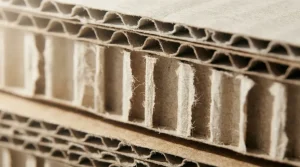
Corrugated cardboard has “memory.” When you compress it, it tries to return to its original shape. This elastic recovery can cause bales to expand or “explode” after leaving the channel.
This phenomenon is caused by fibers resisting the fold. Tests show that creases in the machine direction break fewer fibers, leading to higher springback forces. (Source: RDM Test Equipment)
Overcoming the elasticity of dry cardboard boxes
The drier the cardboard, the more elastic it becomes. In many recycling centers, boxes are dry and rigid.
To overcome this, the baler must apply pressure beyond the material’s yield point. This permanently breaks the fiber structure so it cannot spring back.
Why standard balers struggle with heavy cardboard loads
Standard balers often lack the specific pressing force required to crush multi-wall cardboard boxes effectively. They might produce a bale that looks good initially but softens over time.
This results in “soft bales” that are dangerous to stack and inefficient to transport. A machine must be specifically tuned for the resistance of corrugated board.
Optimizing a waste paper baler for variable material streams
A versatile waste paper baler must handle everything from office paper to heavy cardboard. Office paper is dense and flat, while cardboard is bulky.
Our systems allow for automatic adjustments. The PLC controller can switch parameters to apply different pressures and holding times depending on what is being fed into the hopper.
The function of retaining claws and ram pressure
To fight the memory effect of cardboard, mechanical aids within the baling channel are essential.
How retaining claws prevent material spring-back in the channel
Retaining claws (or dogs) are mechanical devices installed in the channel floor and roof. They act like fish hooks.
When the ram pushes material forward, the claws depress. When the ram retracts to load more material, the claws pop up and grab the bale.
This prevents the compressed material from springing back into the charge chamber, maintaining the density achieved during the compression stroke.
Maintaining continuous pressure for optimal cardboard baler bale density
Density is not just about the peak force; it is about maintaining pressure. The claws allow the ram to retreat without losing the progress made in the previous cycle.
This ensures that every stroke adds to the density rather than just re-compressing expanded material.
The impact of cutting edges on bale integrity
For shear balers, sharp cutting edges are vital. We use shear blades with multiple segments designed to turn cutting edges two times.
A clean cut prevents material from getting caught between the ram and the frame. This reduces friction drag and ensures that the full force is applied to the bale face.
Ensuring dense corners for stable stacking
The corners of a bale are structurally the most important part for stacking. If the corners are soft, the stack will lean.
Proper ram alignment and channel design ensure that material is distributed evenly, creating square, dense corners. This stability is crucial for safe warehousing.
The science of de-aeration in high-speed baling
Cardboard boxes are essentially containers of air. Baling is the process of air removal.
Removing air pockets from multi-layer corrugated boxes
When you crush a box rapidly, air gets trapped inside the flutes and layers. If this air cannot escape, it acts like a pneumatic spring.
Upon release of pressure, the trapped compressed air expands, breaking the wire ties or deforming the bale.
Balancing cycle speed with necessary dwell time
While high throughput is desirable, pressing too fast can be counterproductive for density. The material needs “dwell time” under pressure for the air to seep out.
Our hydraulic systems are optimized to balance high-speed cycling with the necessary compression duration to ensure effective de-aeration.
Techniques for efficient air escape during compression
We design our press rams and channels with tolerances that allow air to vent without letting material escape.
For specific applications, we can adjust the compaction profile to include a brief hold at peak pressure, giving the air those vital milliseconds to exit.
Achieving solid material compaction without bale ties
In some of our specialized applications, like the small format can baler, we achieve solid compaction where no ties are needed.
While cardboard always requires wire ties, the principle remains: better de-aeration leads to a bale that holds its shape mechanically, putting less stress on the tying wire.
How ANIS Trend solutions ensure superior bale quality
We do not offer a “one size fits all” machine. Our approach is to tailor the technology to your specific waste stream.
Advantages of pressing forces up to 205 tonnes
For industrial cardboard recycling, force is king. Our heavy-duty models deliver up to 205 tonnes of pressing force.
This immense power allows us to produce extremely dense bales even with large, rigid industrial packaging that would stall smaller machines.
Using pre-press flaps to handle bulky cardboard waste
Our Preflap technology is particularly effective for bulky cardboard. The flaps pre-condition the material, folding it down before the main ram engages.
This two-stage process ensures that the charging chamber is filled efficiently, eliminating voids that lower overall density.
Automatic recipe management for different material grades
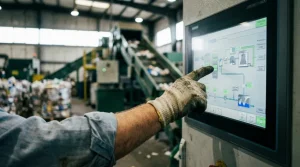
Operators can easily switch between materials using our Siemens PLC touch panels.
You can have a “Corrugated” recipe with high pressure and specific dwell times, and a “PET” recipe with different settings. This guarantees optimal density for every load.
Enhancing durability with Hardox wear plates
High density means high abrasion. To protect your investment, we utilize HARDOX® wear-resistant steel for internal coatings and changeable wear plates.
This ensures that the tight tolerances required for high-density compaction are maintained over years of heavy operation.
Case study: analyzing logistics savings and ROI
Let us consider a theoretical but realistic scenario based on our experience with European recycling plants.
Real-world examples of reduced transport costs
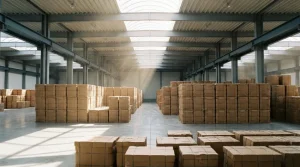
A client processing 10,000 tonnes of cardboard annually was using an older baler, achieving payloads of 18 tonnes per truck. This required approximately 556 truck trips per year.
After upgrading to an ANIS channel baler with high-pressure capabilities, bale density improved, allowing payloads of 24 tonnes. The trips reduced to 417.
That is 139 fewer trucks. At an estimated €600 per average trip, the annual saving is over €83,000 in transport costs alone.
Improving cardboard baler bale density for higher scrap revenue
Paper mills prefer high-density bales because they are safer to store and more efficient to process.
Consistently supplying high-quality, dense bales can often give you leverage to negotiate better rates for your material or secure preferred vendor status.
Environmental impact of fewer logistical movements
Sustainability is increasingly important. Reducing truck movements by 25% significantly lowers the facility’s Scope 3 emissions.
This environmental performance is becoming a key metric for many municipal and corporate tenders.
Long-term savings through efficient equipment selection
The initial cost of a high-performance baler is offset by these operational savings. When you factor in reduced wire consumption and lower maintenance due to robust construction, the ROI is often realized in less than two years.
Summary
Optimizing density is the most effective lever you have to control logistics costs in recycling. By understanding the mechanical requirements—such as high ram pressure, the use of retaining claws, and effective de-aeration—you can transform your operations.
At ANIS Trend, we build machines that deliver these results consistently. From our robust frames to our intelligent software, every component is designed to maximize weight per cubic meter and minimize your cost per tonne.
Frequently Asked Questions (FAQ)
Why do my cardboard bales expand after leaving the baler?
This is due to the “memory effect” of corrugated cardboard and trapped air. If the pressing force is too low or dwell time is insufficient, the fibers spring back. Using retaining claws and higher specific pressure helps prevent this.
How much does bale density affect wire consumption?
Significantly. Denser bales contain more material for the same surface area of wire. Increasing density means you use less wire per tonne of recycled material, reducing consumable costs.
What is the difference between shear and pre-press balers for cardboard?
Shear balers cut excess material to close the bale, which is great for continuous, varied streams. Pre-press balers fold material into the chamber before compression, which is often better for very bulky boxes or plastics to ensure high density without jamming.
Can ANIS balers handle both plastic and cardboard?
Yes. Our balers are designed for multi-material use. Our Siemens PLC allows you to switch recipes (settings) instantly to optimize pressure and strapping for different materials like PET, foil, or cardboard.