


Magnetic separation is a physical separation process that uses a magnetic field to pull magnetically susceptible material out of a mixture, leaving non-magnetic material behind. It needs no chemicals and no added reagents, which is why mining, recycling, food processing and plastics production all rely on it.
The process runs on one property of the feed material: magnetic susceptibility. Iron and steel respond strongly, minerals such as hematite respond weakly, and quartz or plastics do not respond at all. A magnetic separator turns that difference into two clean output streams.
Below is how the principle works, which methods exist, and where each one fits in an industrial line.
Table of Contents
What is magnetic separation?
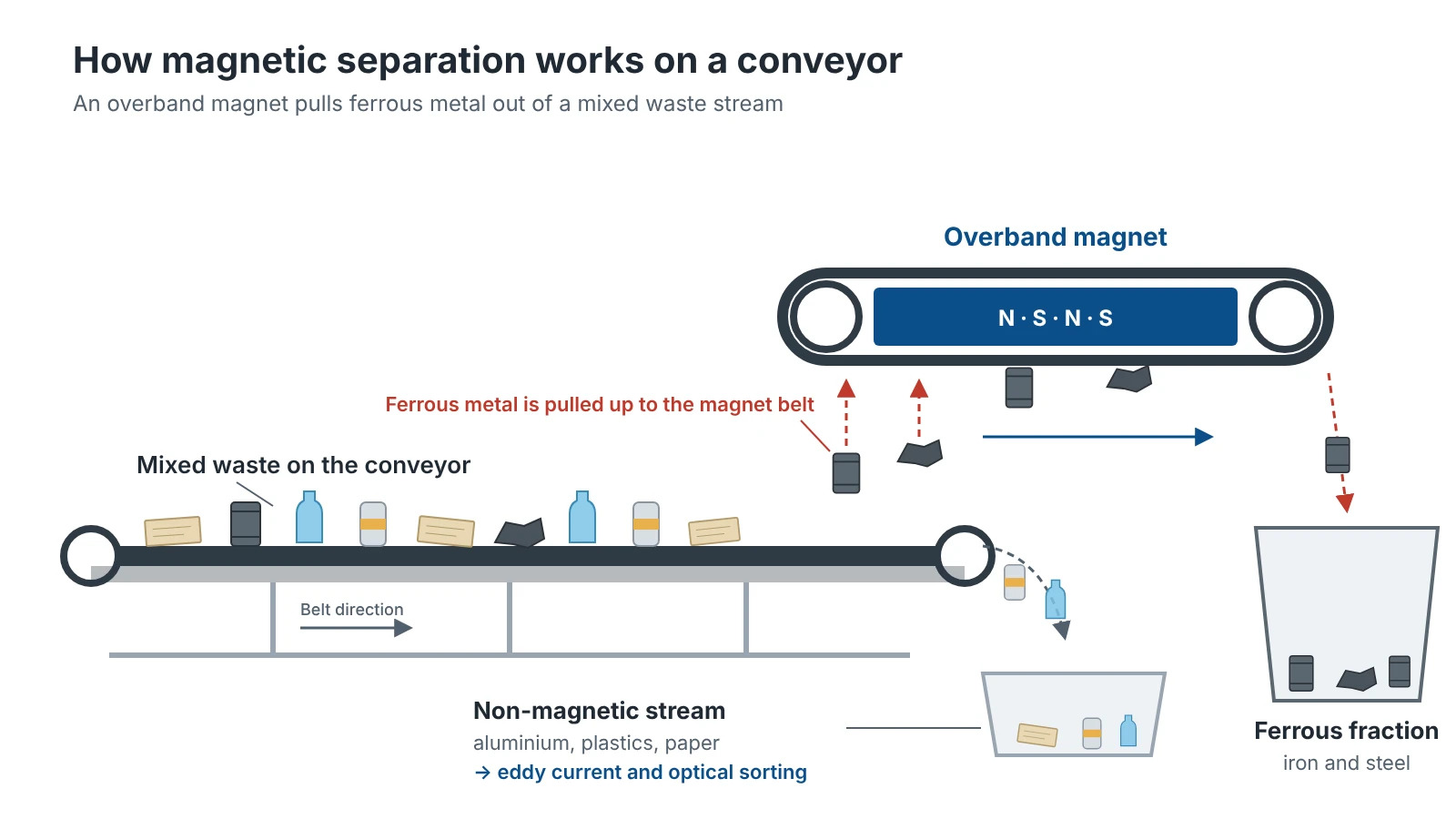
Magnetic separation is a technique that uses magnetic fields to separate magnetic substances from non-magnetic materials. In a recycling line, the separator attracts iron and steel into a separate stream, while non-magnetic material continues along the conveyor.

The technique is used in mining, recycling and food processing to recover valuable material and to remove unwanted metal. In a recycling plant it protects downstream machinery from tramp iron; in mining it concentrates ore before further processing; in food production it keeps metal fragments out of the finished product.
The principle behind magnetic separation
The principle of magnetic separation is the interaction between a magnetic field and the magnetic susceptibility of each particle. Particles that are attracted strongly enough to overcome gravity and drag are pulled out of the stream; everything else stays in it.
Materials fall into three classes, and the class decides which equipment the job needs.
| Class | Response to a magnetic field | Typical materials | Separation approach |
|---|---|---|---|
| Ferromagnetic | Strongly attracted | Iron, steel, magnetite, nickel | Low intensity, permanent magnets |
| Paramagnetic | Weakly attracted | Hematite, ilmenite, chromite, manganese ores | High intensity, electromagnets |
| Non-magnetic (diamagnetic or very weakly paramagnetic) | No practical attraction | Quartz, plastics, aluminium, copper | Not separable by magnets alone; eddy current for conductive metals |
Magnetic fields are generated by specialised equipment called magnetic separators. By controlling the intensity and the direction of the field, operators tune the process to the feed: a weak field takes only loose iron, a strong field also captures weakly magnetic minerals.
Types of magnetic separation methods
Magnetic separation methods are grouped by field intensity (low or high) and by whether the feed is processed dry or in water. Low intensity units use permanent magnets and typically produce surface fields around 0.1 to 0.3 T (roughly 1,000 to 3,000 gauss). High intensity units use electromagnets and reach up to about 2 T (roughly 20,000 gauss).
| Method | Field | Feed | Targets | Common use |
|---|---|---|---|---|
| Overband magnet | Low intensity | Dry | Tramp iron and steel | Conveyors in recycling and waste plants |
| Magnetic drum or pulley | Low intensity | Dry | Ferrous fraction | Continuous ferrous recovery from bulk streams |
| LIMS (low intensity, wet) | Low intensity | Wet | Strongly magnetic minerals such as magnetite | Iron ore concentration |
| WHIMS (wet high intensity) | High intensity | Wet | Weakly magnetic fines such as hematite | Ore that low intensity units cannot recover |
| Eddy current separator | Alternating field | Dry | Non-ferrous metals: aluminium, copper | Recycling, after the ferrous stage |
An eddy current separator is the exception to the rule above. It does not attract material; a rapidly alternating field induces currents in conductive non-ferrous particles, and the field those currents create repels them off the belt. It is always placed after a magnetic stage, because ferrous material left in the feed shortens belt life and contaminates the non-ferrous product.
Applications of magnetic separators
Magnetic separators are used in mining to concentrate magnetite and other susceptible ores. In an industrial waste sorting plant, they recover ferrous metal and protect downstream equipment. Food and pharmaceutical plants use them as a contamination-control step before packaging.
Examples of magnetic separation
The clearest example of magnetic separation is a recycling line: an overband magnet lifts steel cans and scrap iron off a moving conveyor while paper, plastics and glass pass underneath. The recovered ferrous metal goes to a scrap buyer, and the remaining stream is cleaner for every machine after it.
Magnetic separation in mining separates magnetic ores from non-magnetic gangue. Magnetite is recovered with low intensity wet drums, while weakly magnetic ores such as hematite need a high intensity unit to report to the concentrate.
Two more examples show the range of the method. Food processing plants use magnets to pull metal fragments out of product before packing, which protects consumers and equipment alike. Pharmaceutical manufacturers use the same principle to keep ferrous contamination out of medication during production.
Magnetic separation in a waste sorting line
In a typical recycling plant, magnetic separation is installed after the material has been opened and spread into an even layer, but before final manual quality control and baling. An overband magnet is suspended above the conveyor, while a magnetic drum or pulley can be installed at the belt discharge.
After the ferrous fraction is removed, the remaining stream moves to optical sorting, manual picking or an eddy current separator for aluminium and copper. See how this sequence fits into a complete material recovery facility or explore ANIS waste sorting lines.
Frequently asked questions about magnetic separation
What is magnetic separation in simple terms?
It is the use of a magnet to take magnetic material out of a mixture. The magnet holds the iron or steel, everything else moves on, and the mixture leaves as two separate streams.
What is the principle of magnetic separation?
The principle is the difference in magnetic susceptibility between particles. In a magnetic field, a susceptible particle is pulled toward the magnet strongly enough to overcome gravity and drag, while a non-susceptible particle is not.
Which materials can be separated magnetically?
Ferromagnetic materials such as iron, steel, nickel and magnetite separate easily at low field intensity. Paramagnetic minerals such as hematite and chromite need high intensity fields. Non-magnetic materials such as quartz, plastics, aluminium and copper cannot be separated by magnets, though conductive non-ferrous metals can be recovered with an eddy current separator.
What is the difference between magnetic separation and eddy current separation?
Magnetic separation attracts and holds ferrous material. Eddy current separation repels non-ferrous conductive metals such as aluminium and copper using an alternating field. Recycling lines usually run both: magnets first, eddy current second.
Where is magnetic separation used in recycling?
It is used at the front of the sorting line to remove ferrous metal before baling or further sorting. This raises the purity of the recovered material and protects balers, shredders and conveyors from tramp iron.
Is magnetic separation a physical or chemical process?
Magnetic separation is a physical process. A magnetic field moves susceptible material out of a mixture without changing its chemical composition. No chemical reaction or added reagent is needed.
Why magnetic separation matters
Magnetic separation improves recovered-material purity and protects downstream equipment from ferrous contamination. The correct separator depends on feed composition, throughput and the required recovery quality.
ANIS Trend designs integrated material handling and sorting systems for industrial and municipal recycling operations. Contact our team to discuss your material stream and plant layout.